Author Archives: Tom Beedham

Unknown's avatar

About Tom Beedham

Tom Beedham is a Canadian writer and photographer whose work focuses on independent culture, experimental art, DIY communities, and their relationship to the mainstream. He has reported on a spectrum of creatives ranging from emerging acts to the definitive voices of cultural movements. He lives in Toronto, Ontario. He has contributed features to Exclaim!, NOW, A.Side (formerly AUX), Chart Attack, and VICE publications Noisey and THUMP, and has appeared as a correspondent on Daily VICE. Tom is also a co-organizer and curator of the inter-arts series Long Winter, for which he has overseen the publication of an online blog and print newspaper-style community publication, and, in collaboration with Lucy Satzewich, implemented harm reduction strategies for safer event spaces. From 2006-2012, he was Editor-in-Chief of Halton, ON -based youth magazine The Undercroft and served as an outreach worker for parent organization Peer Outreach Support Services and Education (POSSE) Project. He was also a DIY concert organizer in his hometown Georgetown, ON in the mid-2000s.

Guelph strip club story to open Hot Docs

Guelph strib club documentary ‘The Manor’ opens Hot Docs April 25.

Manor documentary to open largest documentary festival in North America

If you’re heading to Toronto this April for the 20th edition of Hot Docs, North America’s largest documentary festival, don’t be surprised to catch a naked portrayal of Guelph strip club The Manor.

With The Manor, strip club manager-turned filmmaker Shawney Cohen offers viewers an inside glimpse at what goes on at the film’s family-owned and -operated namesake in a directorial debut that focuses a lens on a cast including a “motley crew of patrons, staff, drug-addled tenants, strippers, and extended family members,” according to a press release. The documentary will open the festival of over 205 films from 43 countries on April 25.

But it probably won’t be what you expect.

“Very little of the ‘strip club movie’ takes place in a strip club,” Cohen told The Ontarion in an interview following a Hot Docs media release that saw widespread media attention given to the idea of the documentary as a film about a strip club. “I think that frankly a film about a strip club would be a little boring.”

Rather, Cohen insists his film is about his family.

“It’s an intimate portrait of my family running a strip club and the consequences of our livelihoods,” said Cohen.

Cohen was six years old when his father bought The Manor, though he spent ten years working as a computer animator following undergraduate studies before becoming a part of his family’s business five years ago.

“I was way more on the fence about [working at The Manor] at the beginning,” Cohen admitted. “I think it was eye-opening for me because it was a life I wasn’t used to and now – five years later – I kind of love it.”

“For me it almost feels like living in a Bukowski novel,” Cohen added. “I kind of appreciated the lifestyle and I think a lot of the stories that come out of there were kind of vulnerable and beautiful, and I found that in many ways just as beautiful as stories you see in literature and film today.”

Cohen says his film is more about those vulnerabilities – specifically those relating to his family. Upon returning home to Guelph after working in Toronto, he found his father grossly overweight at 400 pounds and about to undergo stomach reduction surgery, while at the same time, his 85-pound mother was refusing to acknowledge her relationship with food.

As a result, Cohen says his film has a lot to do with “body image, weight, and addiction.” To him, The Manor is more of an intriguing setting than an actual subject in his documentary. “I found that to be an interesting juxtaposition.”

In the midst of all this, his younger brother Sammy was struggling to run the club.

The entire project required between two and three years of filming, a process Cohen says involved close to 80 or 90 days of shooting.

“I think films of this nature… you really need to film a lot,” said Cohen. “You also wanna get people comfortable with the camera, so it’s important to film a lot and eventually have the camera be a fly on the wall so that when you’re in your hundredth hour of footage people aren’t aware of it.”

It’s a film about Guelph, but don’t expect to see much of the Royal City in The Manor, Cohen says.

“[There’s] a sign that says ‘Guelph.’ That’s the only indication that you know you’re in Guelph. For me it was important to stick to two locations: The Manor, and my parents’ house. And maybe the hospital.” said Cohen.

The Manor will not receive a theatrical release in Canada until May 10, and has only so far been showcased at film festivals around the world. As a result, the film has yet to receive a rating.

Among many more, other films announced on the Hot Docs docket include Gus Holwerda’s The Unbelievers, a film following the studies of evolutionary biologist Richard Dawkins and theoretical physicist Lawrence Krauss; Marta Cunningham’s Valentine Road, about an eighth-grader that fatally shoots an LGBTQ classmate; Penny Lane’s Our Nixon, toted as a “revealing look at one of the most controversial presidencies in US history”; and Charles Wilkinson’s Oil Sands Karaoke, a story of oil sands workers that kill time off at their local karaoke bar.

The festival runs April 25 through May 5.


(originally published by The Ontarion on March 28, 2013)

Album Review: Depeche Mode – Delta Machine

That in their 33rd year as a band, Depeche Mode open their 13th album with a song called “Welcome To My World” might seem like an ironic gesture, but it’s anything but insincere. With Delta Machine, Depeche Mode put forth an album that serves up some familiar lyrical themes that fit in with the band’s standard fare, but the encompassing sound follows a concept the group’s never pursued before.

Depeche Mode – Delta Machine. Released March 26, 2013 (Columbia Records)

Offering up some easily discernible blues guitar drones on tracks like “Slow” and “Goodbye,” the group pursues a loose theme that sets delta blues up against some of the modernity-exploitive electronic and alterna-dance components that Depeche Mode has relied on throughout their career to arrive at a hybrid sound that explains the Delta Machine heading pretty directly, and the result is an album that is dark and contemplative at once with its musical as well as its lyrical subject matter.

Not short on surprises, the band doesn’t limit itself to the title concept and risk putting out a piece of contrived art, but instead allows itself to branch off from it as well as the contextual framework the band chiseled itself into over the past three decades.

With dark and damaged swamp gospel vocals coupling a throbbing electronic pulse and perforated with an atmospheric chorus, “Angel” is an intelligent inclusion among the melancholy of an album that boasts blues-entwined techno. It’s an obvious choice to precede “Heaven,” the album’s only single released so far. The latter is an emotional rumination of longing and a call for spiritual validation that’s the clear flag bearer for the album. Together these tracks insure fans craving some material that progresses from the group’s traditional lyrical concentrations on spiritual frustrations will remain satisfied.

While the band appears to make an effort to appease what might be less open-minded fans, this labour doesn’t seem to come without a bit of sarcasm. “My Little Universe” is a meditation (if not a satire) on ivory tower isolationism that – with a minimalist glitch accompaniment that at first sits in the background but eventually blossoms to stave off and silence Dave Gahan’s (here notably restrained) vocals – could operate as (perhaps cliché in alternately folk-purist contexts) commentary on the state of an increasingly technologically-involved culture that also signals how self-aware the group had to become before exploring some new avenues for artistic direction. Contrastingly, “Soothe My Soul” seems like more of a crowd pleaser with its dark alternative dance and guitar work on the chorus that is not dissimilar to the chords Martin Gore wrote for “Personal Jesus” in 1989.

If anything counts against Delta Machine, the offering does come off a little long, and perhaps some of the material would fit better on a standalone effort. However, how much can we blame the guys? Delta Machine marks the end of a trilogy of records Depeche Mode has been working on with producer Ben Hillier, so maybe some of the inclusions arrive more out of respect than necessity.

If a little long, Delta Machine remains one of Depeche Mode’s most impressive records – even more so considering how late it comes in the group’s career.

(Originally published by The Ontarion March 27, 2013.)

Album Review: Chelsea Light Moving–’Chelsea Light Moving’

Chelsea Light Moving’s self-titled LP (Matador)

“Smash the control images. Smash the control machine.” When William S. Burroughs penned those words in his 1961-published The Soft Machine, they defined more than their immediate context; smashing control was the purpose for the cut-up/fold-in format of The Soft Machine and the trilogy it belonged to, but it was also the general focus of Burroughs’s life’s work. Working from that premise, we can begin to understand what (former?) Sonic Youth guitarist/vocalist Thurston Moore meant when he presented his new band, Chelsea Light Moving, to the world and toted it as “Burroughs rock.”

To be sure, passing off your music as something that can be directly aligned with a highly esteemed thinker’s raison d’être involves no modest claim making, especially when the legend in question now resides beyond the grave and has no further say in the matter. But any question regarding Thurston Moore’s tact can probably be put to bed in this case; Chelsea Light Moving’s eponymous LP comes over 20 years after its songwriter earned Burroughs’s personal blessing when Sonic Youth’s music was featured on Burroughs’s own readings vs. music album Dead City Radio, and following the author’s death in 1997, Sonic Youth’s association with Burroughs was given further cultural approval when it was featured predominately throughout the 2010 documentary William S. Burroughs: A Man Within.

Sonic Youth never explicitly identified itself as “Burroughs rock,” though it was regarded that way anyway. But is Chelsea Light Moving a rightful heir to that throne solely for the virtue of Moore’s back catalogue?

The answer is an unmistakable No. And Burroughs wouldn’t approve of Moore doing something that was markedly faithful to the Sonic Youth formula, anyway. After all, he did say, “to become an individual again, [an individual must] decontrol himself, train himself as to what is going on and win back as much independent ground for himself as possible.” He associated true individuality with engaging in a Nietzschean sort of constant becoming.

In accordance with Burroughs’s penchant for personal overcoming, Chelsea Light Moving is no vanity project. Moore has done solo work before, but Chelsea Light Moving marks his first time at the helm of an actual band. That’s in stark contrast to how, with Sonic Youth, Moore shared creative responsibilities mostly with fellow guitarist Lee Ranaldo and bassist Kim Gordon (Moore’s wife until their divorce in 2011).

Style and content-wise, the album also offers a history that Burroughs himself could have provided, and they do it in a way that’s never been done before; Chelsea Light offers an unambiguous homage to its genre-sake with “Burroughs” (and Beat poetry more generally on “Mohawk,” which – with a late reference to Darby Crash – also serves as a premature segue for the group’s cover of the 1979 Germs track “Communist Eyes”); “Frank O’Hara Hit,” a track Moore described on the Matador blog as “a meditation on [Julys] through history,” is about the month that included the 1966 death of New York City poet Frank O’Hara; and along with its Germs cover, “Lip” serves as a tribute to hardcore punk from the ’80s, while the chugging “Alighted” digs into sludge elements born in the same decade.

Burroughs wanted to smash all notions of control, and with Chelsea Light Moving, Moore makes good business of the same pursuit. But with this being said, there’s an important way in which Sonic Youth excelled at a Burroughsian enterprise that Chelsea Light Moving ignores.

Some might find it unfair to hold Moore’s new band up against an older act that had time to grow and strengthen as an organism, but Moore and fellow Chelsea Light Moving members Samara Lubelski, John Moloney, and Keith Wood have been at the music game long enough, and the overlapping contexts and intentions of the two groups make comparison here relevant.

One of the greatest appeals of Sonic Youth was the group’s tendency to share the responsibility of songwriting/directing among its members and bounce off of each other’s ideas in a democratic fashion – best discernable in the noise rock meltdowns that made their way into so many Sonic Youth recordings. With Moore providing the sole vocals and his guitar weighing heavy in the mix, Chelsea Light Moving seems to rely on an authority that was less discernable in Sonic Youth’s more recognizably democratic output, and as a result – at least in a structural sense – seems at least marginally less concerned with smashing control than his former band.

But that shouldn’t count too heavily against Moore’s new group. Chelsea Light Moving is not without the collective tantrums of disparate noise that Burroughs must have loved about Sonic Youth, and when they provide those fits, they’re at their best.

Maybe through holding back on the anarchic noise meditations, Moore intended for his audiences to get hungry. If so, it worked.

4/5


(originally published by The Ontarion on March 20, 2013)

Pop Machine: “Junk” won’t cut it


Video response fails to balance MacFarlane’s sexist anthem “We Saw Your Boobs”

Feb 27, 2013

[Trigger warning: contains discussion of images of sexual violence.]

A face-palm prompting pop culture moment as infamous as Seth MacFarlane’s Oscars song “We Saw Your Boobs” is bound to spark parodies, and on Feb. 25, Kevin Gisi made that a reality with “We Saw Your Junk.”

Beginning with a disclaimer reading, “To those who were offended by Seth MacFarlane’s ‘We Saw Your Boobs’ number at the Oscars I hope this helps!” viewers are asked to expect that what’s to come will somehow balance MacFarlane’s male gaze championing anthem that listed onscreen appearances of several actresses’ exposed breasts to 40.3 million viewers. The one thing Gisi’s song has going for it is that it goes after a subject in a position of more privilege than that tackled by MacFarlane, but what’s ultimately put forth is more of an apologist statement that is more of a trivialization of legitimate backlash MacFarlane received in the wake of hosting the Academy Awards.

Gisi’s song lists films in which actors’ naked penises are featured onscreen, but it ultimately fails to address the most offensive subtexts of “Boobs.”

[Article continues after video]

What’s not overt to all that watched MacFarlane’s number was that many of the moments referenced involved sexual violence, predation, and sexploitation. As Katie McDonough pointed out in an article for Salon, the breasts viewers glimpse in The Accused, Boys Don’t Cry, Monster, Monster’s Ball are shown in a rape scene, a medical examination following rape, a bathroom scene following a rape (in which the breasts are bruised), and a sex scene in which the line between consent and resistance isn’t clear and the character can be read as an object of white male sexual exotification of the black female (respectively). MacFarlane also referenced the real life privacy violation of Scarlett Johansson, in which nude photos from her phone were leaked to the Internet.

MacFarlane cemented the song as one big slut shame by glorifying actresses that have yet to bare their breasts on screen by including a clip of Jennifer Lawrence snapping her fingers from the crowd after it’s noted that we haven’t seen her naked bosoms on-screen. Gisi actually participates in the same activity when he notes several movies Ron Jeremy’s penis was not shown in on-screen, then goes on to sing “But that doesn’t make up for the porn.”

[Article concludes below video]

Critics of MacFarlane’s detractors have pointed to the fact that many of the actresses featured in MacFarlane’s performance were in on the so-called “gag,” but that didn’t make it any less sexist; all this signals is a Hollywood widely insular to the systemic oppression of women.

To wit, satire, sarcasm, and gross-out postmodern pastiche has been MacFarlane’s comedic vehicle of choice across all of the creations he’s steered directly (Family Guy, The Cleveland Show, etc.), and it’s possible to concede he was aiming to start a discussion. But I’m not about to become a MacFarlane apologist. We’re at an embarrassing stage in our pop cultural history if we’re willing to accept misogynist, homophobic, racist, and otherwise oppressive statements or actions as “clever humour” when the source material is simply receiving an application of literal or metaphorical quotation marks. We need to stop being a party to that.

(Originally published Feb. 27, 2013 on The Ontarion)

Pop Machine: Watching the throne at the Grammys

Despite taking strides, Grammy disappointments play like a broken record

Feb. 14, 2013

Frank Ocean performs at the 2013 Grammy Awards

Frank Ocean performs at the 2013 Grammy Awards. (Courtesy)

As an award show, the televised portion of the 55th annual Grammy Awards lived up to its name in several ways by showcasing some major accomplishments to a wide (albeit comparatively lower) viewership on Feb. 10.

Although they continued to glorify Chris Brown with an award nomination, a seat at the show, and several cuts to his reactions throughout the night, the Grammys denied the woman beater and accused parole violator further celebration in his nominated categories, instead awarding Best Urban Contemporary Album to Frank Ocean, who Brown allegedly jumped in a parking lot on Jan. 27.

Taylor Swift kicked off the night’s ceremonies with her holier-than-thou anthem “We Are Never Ever Getting Back Together” but was ultimately snubbed for an award – great retribution after a performance that included a modified na-na na-na boo-boo spoken portion where Swift relished in the fact that she’s too “busy opening up the Grammys” to speak with an ex, as well as an extra emphasized rendition of the song’s aping of its subject’s preference for “some indie record that’s much cooler than” the singer’s (a now tired and platitudinized criticism of so-called hipsterism and ultimately a slap in the face to the musicians that made it to the awards without riding there on the coattails of major labels).

While this year’s award presentation took some major strides, the cold shoulder it offered rap artists in major, universal categories such as Record of the Year, Album of the Year, Song of the Year, and Best New Artist continued a long history of snubbing that transpires like the course of a record that is very broken, and definitely not one that is scratched in intentionally rhythmic and musically interesting ways.

The perpetuation of that history lends credence to criticism that the Grammys are institutionally racist.

That’s not to say that musicians working within the rap genre represent all black artists or “black music,” or that the Grammys ignores the contributions of black performers. The Grammys introduced rap award categories in 1989 that have since changed, black musicians/performers have been acknowledged for success in Grammy award categories outside of rap, and artists that have not been black have been nominated in rap categories. What is concerning about Grammy Award handlings of the rap categories and black performers is that where it has honoured black performers operating outside of the genre, it has typically been for music with features generally recognized as typical of or more popularly practiced by contemporary white musicians (e.g. the singing typical of R&B performances), and its failure to represent excellence on a general scale for music typically performed by black contemporary artists.

An exclusion of rap music from nominations in the larger general categories was made particularly questionable this year, after Jay-Z and Kanye West took away several prizes for two songs off of their Watch the Throne – the Best Rap/Sung Collaboration category for “No Church in the Wild” and Best Rap Song and Best Rap Performance for “N****s in Paris” – but failed to receive nominations in broader categories as an album that enjoyed massive critical and commercial success around the world.

To their merit, this year’s Grammy’s did include an end of program rap rock performance featuring a collaboration between evening host LL Cool J, Chuck D (Public Enemy), Tom Morello (Rage Against the Machine, The Nightwatchman), DJ Z-Trip, and Travis Barker (Blink 182, Transplants, etc.). But the treatment of that performance lent itself as yet another suggestion of the program’s ultimate priorities when the audio and visuals were interrupted and covered over with credits and sponsor messages throughout. Viewership is also known to drop as the event goes later into the night.

(Originally published in The Ontarion on Feb. 14, 2013)

Hillside Inside reviews: Elliott Brood at River Run Centre – Feb. 1, 2013

A welcome Brood: Elliott Brood gets packed River Run Centre on its feet

Feb 7, 2013

Elliott Brood played the River Run Centre Feb. 1 as part of Hillside Inside 2013.

Elliott Brood played Guelph’s River Run Centre Feb. 1 as part of Hillside Inside 2013.

Elliott Brood doesn’t play many theatres.

Delivering a breed of alt-country that’s been appropriately dubbed “death country” for its deployment of a stripped down, no-frills folk-punk approach to performance that is a defining feature of the more extreme Norwegian subgenre of death metal bands, it’s understandable that the three-piece pointed out it was more acquainted with the sticky floors and gloom of the Toronto bar scene when it played the main hall at Guelph’s River Run Centre on Feb. 1. But that’s not to say the trio was entirely uncomfortable playing the theatre setting.

“It smells good in here,” singer and multi-instrumentalist Casey Laforet noted to the crowd in a lighthearted nod to the virtues of the comparatively sterile environment.

All joking aside, that Elliott Brood played the more spacious setting of the River Run Centre was no miscalculation in planning; just prior to their Hillside Inside performance, the group catered to two sold-out audiences at the Dakota Tavern in Toronto on Jan. 30 and 31.

The band’s not without its Guelph history, either. Between songs, the group also gave a shout out to local watering hole the Jimmy Jazz, where they said they played their first show outside of Toronto.

They also recalled a flash mob that broke out last summer during a Hillside performance of “If I Get Old” before delivering a slowed down variation of the 2011 single.

Despite having been faced with the unusual sight of a crowd that watched from well above their heads, the band didn’t shrink in discomfort. Urging the audience to make noise as they entered the stage (to which they were met with obliging howls), the band dove into a set including singles “Second Son,” “The Bridge” (dedicated to evening MC Vish Khanna), and a “cooperating ukulele” performance of “The Valley Town.”

“Oh, Alberta” had everyone on their feet, even if they were guilted into it (a fan shouted out the track title in between songs and the band asked him if he would be the first to stand up and clap along because of it). But it is hard to justify sitting down while watching Elliott Brood perform. Even if two of the group’s three members play with their behinds planted firmly in seats more comfortably padded than your own, it is easy to understand why; all members handle multiple instrumental duties – almost always simultaneously. In particular, Laforet plays guitar while filling in the low end with his feet – tapping bass pedals along with the chords.

The group also performed “Lindsay,” a cover of “Old Dan Tucker,” and the longing-but-joyous “Miss You Now.”

On Feb. 2, the band tweeted thanks to the crowds at their Guelph and Toronto performances for “a great send-off” to a European tour that will span Feb. 7-March 3.

Following the death country trio were Great Lake Swimmers (GLS).

With a turned down, atmospheric take on folk rock, GLS were perhaps more appropriately situated on the main stage at the River Run Centre, especially when they brought out members of the Suzuki String School of Guelph. The school – specially instructed for the evening by GLS fiddler Miranda Mulholland, who was once herself a student at the school – appeared throughout the set to perform “Quiet Your Mind,” “A Song for the Angels,” “The Knife,” “On the Water,” “Changing Colours,” and “Changes with the Wind,” among others.

The quintet ended its performance with an acoustic call and response rendition of “Still.”

(Originally published in The Ontarion on Feb. 7, 2013)

Unleashing a dragon at eBar

Polaris shortlisters Yamantaka // Sonic Titan bring theatrical concert act to Guelph

Jan. 24, 2013

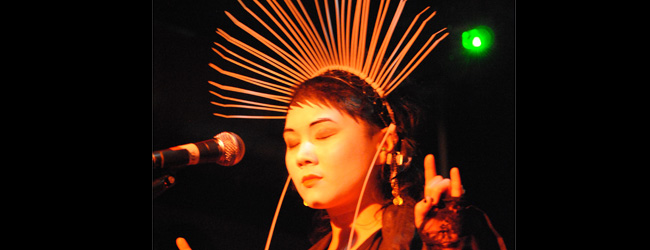
Yamantaka // Sonic Titan played eBar (Guelph) on Jan. 17, 2013.

Yamantaka // Sonic Titan played eBar (Guelph) on Jan. 17, 2013.

Yamantaka // Sonic Titan (YT//ST) fans who turned out to eBar on Jan. 17 might have been confused when the headliner began its set with just three members occupying the stage, but any confusion was soon resolved after a dragon parted the sea of concertgoers, slowly worming its way up to the stage.

You read that correctly: YT//ST unleashed a dragon on its audience.

Held aloft by YT//ST director and vocalist Ruby Kato Attwood and Ange Loft (vocals, percussion), the black-and-white paper dragon made an appearance in the vein of Chinese Dragon Dance ceremonies dating back to the Han Dynasty, and it was just one of the many cultural signifiers concert-goers were presented that night.

This is standard fare for the YT//ST camp, and mention of the routine only brushes the surface of what the group has in store.

Originally formed in Montreal by Ruby Kato Attwood and Alaska B – both of mixed Asian-European heritage – YT//ST identifies itself to its audiences as an “Asian, Indigenous and Diasporic Art Collective,” and as such, cultural aesthetics gleaned from the Eastern and Western cultures (Nôh, J-Pop, C-pop, manga, Chinese Opera, First Nations Mythology, Iroquois core, prog, black metal, punk and noise rock, to name a few discernable influences) are staples in their diverse output – musically, visually, theatrically, and philosophically. The group also invented the term “Noh-Wave” (a pun on Nôh theatre and the stripped down, experimental No Wave scene of mid-’70s New York City) as a genre category that affords them to avoid the exhausting practice of placing art within predetermined boundaries when being asked to describe their style to outsiders.

“People wanna gatekeep and we’re just kind of more interested in kind of… You know, you point in a billion directions at once and they’re too busy looking, and by the time they look back you’ve already stolen everything,” Alaska B – who performs vocals, drums, and keys, in addition to carrying out other duties for YT//ST – told The Ontarion in a back office of the eBar while opening acts primed the audience for the group’s Guelph performance.

To wit, the process of presenting appropriated (“mal-appropriated,” B emphasizes) cultural aesthetics in a hybrid pastiche is a controversial avenue for any artistic undertaking to pursue. But it’s one B and the rest of the group will argue for.

“I think that’s literally a bullshit catch-22,” said B. “You police expression and then you selectively grant – based on your political opinion – what is appropriate, authentic, or real. And I think that’s a trap that you fall into automatically, based on your ethnic background, cultural appearance, et cetera. And that’s something you can’t escape from.”

“What I find funny is how whenever we played without saying who we were, people [said] it anyways. And so, it was like, ah, we’ll just say what it is and that means that we can have the conversation on our terms.”

The group provides representations of cultures that are selective and at times potentially cartoonish, but B maintains the collective refrains from participating in exotification of its source cultures because of its authentic approach to the subject matter; B is of Chinese-Irish heritage, Attwood is of Japanese-Scottish descent, and Loft is from the Kahnawake Mohawk Territory along the St. Lawrence River in Quebec, for starters.

“To exotify means that you have to distance yourself from what you’re doing. We’re not distancing ourselves at all.”

“I don’t think what we do is any more offensive, culturally, than punk rock is offensive in a class sense. How wearing the signifiers of a lower class is considered somehow revolutionary no matter who you are, while to knowingly don cartoon kind of costumes of your ethnic identity is somehow offensive,” B philosophized. “It kind of puts us in a position of like, you better dress traditional like it’s 1850, or you better dress like a white boy. Otherwise you get no space in between or you’re somehow gonna be racist.”

Something B finds more concerning is the tendency for bands that cannot claim the cultures they appropriate as having provided their ethnic identities to avoid acknowledging the positions of privilege they access those sources from.

“I find it funny that we have to have this conversation while bands like Indian Jewellery, Indian Handcrafts […] there’s so many bands that just kind of get away with whatever,” said B. “And they just say it, they do it, they appropriate, and ’cause they never ’fess up to it, people can dodge the conversation.”

The performer argues that YT//ST necessarily engages its audiences in a critical reading of the music scene the collective operates within.

“By critiquing us, you’re inadvertently critiquing the entire indie scene.”

Whatever your stance on the political motivations of the collective, for a group that began as a large scale theatrical performance art project – perhaps lubricated by a 2012 shortlisting for the Polaris Music Prize that brought them international attention – YT//ST has come to offer a concert experience of undeniable allure. While the group’s sound is often fragile, sweet, and atmospheric, also present is a brooding energy that builds up to an incendiary fever pitch. At the group’s Guelph performance, this was realized when, late in the set, the audience erupted into a bouncy mosh pit that even saw audience members crowd surfing throughout the eBar.

Loft indulged the enthusiastic audience by joining them in the pit when the group dove into an encore performance of “A Star Over Pureland,” returning only at the end of the track to deliver a booming chant.

If you feel YT//ST’s already impressive dossier doesn’t leave much room to grow, the group is also currently absorbed in the process of putting together a side-scrolling video game (a play on YT//ST’s initials, it’ll be called Your Task // Shoot Things) scored with an original soundtrack from the collective.

“It’s like a full-on little rock opera with a narrative that you play through,” said B.

The group is hoping to reach out to the public for input at a series of work-in-progress presentations and eventually involve a studio, but B is determined the game will be YT//ST’s own.

“There are bands that’ve had video games based on their franchise, where they order them like an advergame – like the Skrillex Quest. The difference is, is that as far as I know, none of them actually took the time to sit around and fart out code. So we’ll be probably the first band to ever make our own video game from start to finish.”

B imagines the process could take until early next year, but YT//ST fans won’t have to wait until then for new material.

“We’re also recording our second record,” said Attwood.

“We start recording in the next couple months,” said B. “We hope to have a record out by the end of the year.”

Beyond that, the group just has touring on its minds.

“We have some performances coming up, but we can’t announce them yet,” Attwood added. And with summer festival season not too far in the distance (and their lineup announcements approaching even sooner), that could mean augmented exposure for the industrious art collective.

(Originally published in The Ontarion on Jan. 24, 2013)

Q&A: Yamantaka // Sonic Titan’s Alaska B. and Ruby Kato Attwood


Yamantaka // Sonic Titan played eBar (Guelph) on Jan. 17, 2013.

Yamantaka // Sonic Titan played eBar (Guelph) on Jan. 17, 2013.

From singling themselves out as an “Asian, Indigenous, and Diasporic Art Collective” to inventing “Noh-Wave” (a pun on Nôh theatre and the stripped down, experimental No Wave scene of mid-’70s New York City) as a genre category to invoke when describing its style, Montreal and Toronto-based Yamantaka // Sonic Titan (YT//ST) like to have things on their own terms. The group’s been making waves since it landed a spot on the shortlist for the 2012 Polaris Music Prize, so when they came to Guelph Jan. 17, I had to get an interview straight from the source.

Tracking down YT//ST directors Alaska B. and Ruby Kato Attwood just before their performance at eBar (for the review, click here), I spoke with the group about its confrontation of the indie scene’s standards of authenticity, a video game the collective currently has in the works, their lack of enthusiasm for Wellington Trailhead, and their tongue-in-cheek affinity for “cerebral cougars.”

Tom Beedham: Welcome to Guelph!

Alaska B.: [Contemplating a bottle of Wellington Trailhead] This isn’t very good.

Ruby Kato Attwood: (Laughs)

TB: No, I’d drink the SPA instead.

AB: This is what they gave me when I gave them a ticket. It’s better than [Molson] Ex…

TB: Fair enough. Did you just get into the city? or did you have some time to explore?

AB: No, we just got in. Never been here before.

TB: Oh. Well, it’s a nice city. A little too much snow for my liking right now, but we get good music. I was talking to Ruby just before we sat down… you guys started sort of touring around Ontario last weekend, but you took the week off so you could work. Any memorable stories from the road so far?

RKA: People were crowd surfing in Ottawa. That was pretty cool.

AB: Security didn’t like that.

TB: No? Is that unusual for you? Crowd surfing at a YT//ST show?

AB: Um… I find that some people don’t understand what kind of band we are, so they get kind of confused. They’re like, “Am I supposed to? Am I not supposed to?”

I like it when people do, because it shows that they get that we are kind of like metal heads and punks under it all. Junior High never dies!

RKA: At the same time, though, there were some of our more sensitive fans getting squished. I felt bad for them.

AB: Nah, it builds character.

TB: It’s true. You learn a lot of lessons in the pit.

RKA: Yeah. Umm… there’s no more stories I can think of.

AB: Uhh… I met the parents of half of the band Boyhood. They were very nice.

TB: You just called yourselves a band, which is interesting because anywhere that I’ve read about you guys, you’re identified as an art collective.

AB: We switch with little-to-no notice.

TB: Besides obvious differences such as your performance work, why do you operate under that label rather than identifying yourselves as a band?

AB: ‘Cause we do more than what a band – in their right mind – would do. If we were just a band, we’d make more money and life would be easier, but then we wouldn’t be doing it for the glory. So… you get more babes when you’re a collective than when you’re a band.

RKA: Yeah. That’s the main reason.

AB:  Cerebral babes.

O: Cerebral babes?

AB: Less cougars, more cerebral babes. Or cerebral cougars.

RKA: Cerebral cougars, best-case scenario.

AB: Smart, older women.

TB: So why has it been so important for you guys to take such a multi-media approach to this band, cerebral babes and cougars aside?

AB: Well, we started that way. We started as a performance art kind of entity.

RKA: And we were also in a band, but it wasn’t the same project.

AB: Yeah, we were in another band called Lesbian Fight Club.

TB: Mhmm.

AB: We have an EP online somewhere still.

TB: I haven’t heard it! I was looking for it – couldn’t track it down.

AB: It’s on MySpace I think.

RKA: Yeah it’s still on MySpace.

TB: Oh, MySpace. Okay. I just see MySpace links and I assume it’s dead.

AB: Oh yeah, it’s from a long time ago. You know, I think we should re-release it.

RKA: Yeah. That would be cool.

AB: Yeah it’d be cool! People would hear it and they’d be like “Oh…you guys totally foresaw this dubstep kind of hippy noise thing.” It’s really dancehall-influenced noise music from around the mid-2000s.

RKA: But then we did just performance/underground/weird stuff for a long time and then we made the record.

TB: There’s been a lot of talk of the cultural aesthetics that you guys appropriate within your project.

AB: Mal-appropriate. We mal-appropriate. [Ruby laughs.] It’s like a malapropism. It’s like where you quote something and you quote it wrong.

TB: As a group that describes itself on its website as an “Asian, Indigenous and Diasporic Art Collective,” has there been any concern with exoticising yourselves or the cultures that you say you mal-appropriate?

AB: Yeah! I think that’s the question. I think that’s literally a bullshit catch-22. It’s this game of like…you police expression and then you selectively grant – based on your political opinion – what is appropriate, authentic, or real. And I think that’s a trap that you fall into automatically, based on your ethnic background, cultural appearance, et cetera. And that’s something you can’t escape from.

If you’re a band from Japan and you play very Western music and there’s really nothing specifically Japanese about it, people will still call you a Japanese band from Japan. And what I find funny is how whenever we played without saying who we were, people say it anyways. And so, it was like, ah, we’ll just say what it is and that means that we can have the conversation on our terms.

When it comes to authenticity and appropriation and exotification, I think that…to exotify means that you have to distance yourself from what you’re doing. We’re not distancing ourselves at all. I feel like what we do comes from…you know, I don’t think what we do is any more offensive, culturally, than punk rock is offensive in a class sense. How wearing the signifiers of a lower class is considered somehow revolutionary no matter who you are, while to knowingly don cartoon kind of costumes of your ethnic identity is somehow offensive. It kind of puts us in a position of like, you better dress traditional like it’s 1850, or you better dress like a white boy. Otherwise you get no space in between or you’re somehow gonna be racist.

I find it funny that we have to have this conversation while bands like Indian Jewellery, Indian Handcrafts—

TB: Neon Indian…

AB: Neon Indian! Gang Gang Dance… there’s so many bands that just kind of get away with whatever. And they just say it, they do it, they appropriate, and ’cause they never ’fess up to it, people can dodge the conversation; we are insisting on having the conversation, because by critiquing us, you’re inadvertently critiquing the entire indie scene.

TB: Very cool. I like you a lot.

RKA: [Giggles.] It’s a little trick.

AB: Ha!

TB: Besides all of the Eastern cultural aesthetics, where else do you get your inspiration? You mentioned punk and metal.

AB: Whatever.

TB: Whatever?

RKA: Whatever.

AB: We live in an area post-boundary. When we were in high school in the ’90s, you needed to wear the uniform of the kind of music you listened to and it had to be the version from the specific year, or you had to be super old school, date someone in their 20s, and dress like it was 10 years prior. And then you had to talk about how you saw this band when you were 12 or whatever.

Nowadays it’s so much more… everything is worn and discarded – like an outfit. So it’s like right now this band represents what I’m feeling but tomorrow I’m gonna put something else on my Tumblr that’s nothing to do with that. Because we’re actually very nuanced, complicated human beings, not genre archetypes. And I think that because we live in that kind of age, and the same way that we look at culture as nothing sacred, that would go for all cultural expressions.

There’s kind of ’scuring and lampooning of many things that we definitely have our specific focuses [on].

I think people are… they hear a lot of words and then they immediately start assuming a lot of stuff, and then for us it’s like, “No, no assumptions.”

I hate when people hear [our music] and they’re like, “Well where’s the Peking opera influence?” It’s like, what the fuck do you know? When’s the last time you saw Peking opera and could tell what influenced me? Like, I’ve actually seen it performed. In China. “Tell me when you did that.” When I did that, it inspired certain elements of rhythm and performance that…you don’t get? Too bad – it’s not my problem you don’t get it. You know? And it’s like trying to find these signifiers…just ’cause you put a name, doesn’t make it… your interpretation of what that means may not be what we mean when we say it.

TB: Of course.

AB: If someone were to say, “Oh that’s proggy,” what does that mean? It’s got synthesizers? Or is it that it’s got all kinds of motivic composition? or weird time signatures? What does that mean?

People wanna gatekeep and we’re just kind of more interested in kind of… You know, you point in a billion directions at once and they’re too busy looking, and by the time they look back you’ve already stolen everything.

TB: That’s a very cool way to put it. Now, this is switching gears, but let’s talk about this video game you’re putting together. I was reading about this today. It comes out this weekend – is that correct?

AB: No… that’s the confusion. Okay. The weekend is actually… We have a closed group of people who have signed up for our mailing list. So people can sign up for the mailing list and then we have these audience engagement events. The one this Saturday is a private event for a small number of people but – kind of shout outs for whoever signed up – we’re currently full. And what we do is we do series of interviews and presentations of work-in-progress.

Making a video game isn’t something you just fart out in a weekend. It’s a very long, drawn out process.

We’re in the early design phase, so Saturday will be the first time we engage with anybody from the public and start talking about what we’re making and basically canvassing our fans and people’s interest in games so as to see what they want to see out of it or what kind of systems they prefer so that we can make the best educated decision on how to move forward with creating a game for our fans and for people who haven’t discovered us yet.

TB: What’s the vision for the game, so far (if there is one)?

AB: It’s kind of like a side-scrolling shooter that’s designed to be for PC, mobile, and possibly… You have to get special approval for anything Xbox, PS3, or Wii. And it’ll be partially high speed arcade shoot ’em up kind of like a Contra or Metal Slug mixed with more of a side-scrolling shooter like Gradius-style sections that are set to music so that the enemies as well as reactions to the environment are responsive to the music that plays.

It’s like a full-on little rock opera with a narrative that you play through.

TB: Aside from being a sort of rock opera that features your music, how else does the game fit in with everything you’ve done as a collective? How did you arrive at the idea for the game?

AB: Well, we’ve been doing a lot of new media since the beginning of [YT//ST]. We have our own lighting system – which is actually down tonight; it needs to be repaired, cared for – and we’ve worked with robotics right from our first performances, on-and-off.

I have an animation degree, and the other collaborative member, Aylwin Lo, is a programmer, so he’s working on the game, mostly in time with me.

It just seemed like a logical next step. I think that the visual art, jumping to music, back to visual art is a much bigger jump than from any of those media to a video game. I think a video game is one of the only forms of media that incorporate not only audience interaction, but also sound, time, visual, and animation, all into one package. So instead of trying to make a theatre event that people have to show up to, or having to tour to all these different places, we decided it’d be best to make something like a game where people can actually engage and play it over and over again.

And I think we’ll also be the first band to make their own video game. There are bands that’ve had video games based on their franchise, where they order them like an advergame – like theSkrillex Quest. The difference is, is that as far as I know, none of them actually took the time to sit around and fart out code. So we’ll be probably the first band to ever make our own video game from start to finish.

TB: Who from the collective is doing what specifically with the game?

AB: I’m lead animator and designer.

The rest of the band are on as consultants. So they work on certain sections. There’ll be a lot more [information] once we enter the full-on process.

We’ll probably be hiring animators and so on. There’s just no way you can finish a game in a reasonable amount of time [with YT//ST’s personnel]. So when we enter full production we’ll probably be hiring people out or working in time with another studio; at this time we’re just making a demo.

RKA: And the art and all the designs and everything are coming out of our sketchbooks.

TB: Not that a video game isn’t ambitious enough, but what comes next after that? Can we expect a follow-up to your debut?

RKA: Well we’re also recording our second record.

AB: Yeah! We start recording in the next couple months. I don’t know what the timing’s gonna be… In the next year or two. We hope to have a record out by the end of the year, and the video game’s aimed for early next year. It’s a long process.

RKA: We have some performances coming up, but we can’t announce them yet. So just touring and our record and—

AB: Binge drinking.

RKA: Binge drinking, thrill seeking… the cerebral babes take up a lot of time. I’ll tell you that much. A lot of talking.

AB: Cerebral babes smoke a lot of weed.

RKA: They smoke so much weed. [Laughs]

TB: Wrapping up, can we expect to hear any of the new material tonight?

RKA and AB, in unison: Yes!

TB: Awesome. Thanks for your time. Looking forward to the show!


(Originally published by The Ontarion on Jan. 23, 2013)

2012 in Concert Stubs

Alexisonfire at Sound Academy Dec. 29, 2012 (their second-last show ever).

Alexisonfire at Sound Academy Dec. 29, 2012 (their second-last show ever).

It’s that time of the year when everyone tries to take stock of the chaos of the past 12 months, so for the sake of documentation, I’ve made a list of all the bands I managed to catch in 2012. I was only offered a short sample of some of these acts at festivals, but a lot were at shows of their own. There were also a lot of really stand-out performances in this mix and it’s coincidentally the great time of annual top 10/20/25/50/whatever lists, so maybe I’ll get around to picking out some of my favourites as well.
Here’s who I checked out in concert this year, through work or out of my own volition:
  • Action Bronson
  • Alexisonfire (twice)
  • Arctic Monkeys
  • AWOLNATION
  • Bad Religion
  • Ben Caplan
  • Black Label Society
  • Black Lips
  • The Buzzcocks
  • Cancer Bats (twice)
  • Ceremony (twice)
  • Dan Mangan
  • Death Grips
  • Deftones
  • Descendents
  • DIANA
  • Dillinger Escape Plan
  • Explosions in the Sky
  • The Flaming Lips
  • Feist
  • Florence + the Machine
  • Fucked Up (thrice)
  • Girl Talk
  • Goatwhore
  • Godspeed You! Black Emperor
  • Gogol Bordello
  • Greg Ginn and the Royal We
  • GWAR
  • The Hives
  • Hollerado (twice)
  • In Flames
  • Jimmy Cliff & Tim Armstrong
  • Justice
  • Kids & Explosions
  • Killer Mike (twice)
  • Less Than Jake
  • Lowlands
  • Madness
  • Marilyn Manson
  • Mazzy Star
  • MellowHype
  • METZ
  • Moneen
  • Noel Gallagher’s High Flying Birds
  • NOFX
  • OFF!
  • Protest the Hero (twice)
  • Pulp
  • Radiohead
  • Raekwon and Ghostface Killah
  • Refused (twice)
  • Rival Schools
  • Slipknot
  • Snoop Dogg & Dr. Dre (feat. the Tupac hologram, Eminem, 50 Cent, Wiz Khalifa)
  • Shotgun Jimmie
  • Squeeze
  • Suicidal Tendencies
  • System of a Down
  • Teenage Head
  • Tool
  • Trash Talk
  • USS
  • The Wooden Sky

Benefit displays softer side of intergalactic barbarians

Gwar performance at punk benefit for food bank lifts veil of band’s mythos
Review and photos by Tom Beedham

Around quarter after 10 in the evening on Jul. 14, a van rolled into Riverside Park, dispersing a horde of concertgoers to the left of the open-air concert shell. The crowd knew it was coming. They’d gathered around the stage half an hour before in hopes of catching a good view of a rare performance from “Rawg,” an unmasked incarnation of the satirical shock rock ensemble Gwar. Informed by show promoters that the group’s lead singer Dave Brockie (perhaps better known to fans as Oderus Urungus – the intergalactic long sword-wielding barbarian character that Brockie has suited up as at regular Gwar concerts since the group’s 1984 premiere) was en route from the Toronto airport, fans were told that getting Brockie onstage as fast as possible would require some cooperation.

Spilling out of the van with a growler of beer in hand, Brockie was hailed with cheers and screams upon arrival. After some brief remarks about missing a flight out of San Diego and waking up in a puddle of his own vomit – with guitarist Mike Derks (AKA Balsac the Jaws of Death), bassist Jamison Land (AKA Beefcake the Mighty) and drummer Brad Roberts (AKA Jizmak Da Gusha) already waiting on stage – the band dove into their set.

Later in the evening, Brockie addressed the novelty of the performance. Claiming that his Oderus Urungus costume was lost somewhere between the San Diego and Toronto airports, he thanked the audience for coming to see Gwar without its usual frills.

“This is something not many people get to see. It’s also something not many people want to see,” the singer quipped. Aside from the costumes, the band’s regular concerts are elaborate productions featuring intricate stage decorations, human “slave” stage extras, and onstage theatrics that include simulated decapitations and spraying audiences with fake blood.

All joking was set aside, however, when Brockie formally introduced the audience to Gwar in its more (un)familiar, human form; the singer was forced to speak to a vacancy in the lineup.

From as far back as 1987, although it has seen many members come and go, Gwar has steadily operated (as steadily as a group of space thugs that sometimes claims to be addicted to crack cocaine ¬– including members that boast smoking whole planets composed entirely of marijuana – can operate) as a five-piece band. That changed on Nov. 3, 2011 when guitarist Cory Smoot was found without vital signs by his fellow band members, just hours after performing a gig in Minneapolis, Minn.

Following an autopsy over a month later, Gwar issued an official statement that included words from Coroner William Masselo, MD claiming Smoot “died from a coronary artery thrombosis brought about by his pre-existing coronary artery disease.”

Following the tragedy, the band retired Smoot’s character Flattus Maximus, while official Gwar lore updated itself to claim that Flattus stole Gwar’s spaceship to return to his home planet, ‘Planet Home’.

But at Riverside Park, Brockie left the myth of the band behind to pay respect for his friend and bandmate. Adopting an earnest tone of solemnity, the singer spoke of how Smoot’s passing was a reminder of the fragility of life, and in a moment of silence looked to a star-riddled sky with a concentrated stare and a raised finger pointing towards infinity before his band cued up another song – a notably respectful motion from a group that has explained the exits of past band members with stories of characters mistakenly drinking bleach thinking it was liquid crack cocaine.

It was not the only tender display of emotions witnessed during the band’s set. Brockie also took time to address his regrets for Lamb of God frontman Randy Blythe, who was arrested in Prague on manslaughter charges on Jun. 27.

Blythe was arrested over allegations that he shoved a 19-year-old fan off a stage at a show at Prague’s Abaton club in 2010. It is alleged that Blythe’s actions resulted in the fan falling into a coma and eventually dying 14 days after the fall caused a brain hemorrhage. Despite having posted a $200,000 bail on Jul. 3, Blythe has been ordered to remain in the Czech Republic, where he has remained until the time of this publication.

Gwar spent 2009 touring the United States extensively with Blythe and his band, and Brockie has also issued sizable blog posts about his friend’s situation.

Despite the logistical nightmare of having audience members on stage that Brockie’s vocalized regrets called attention to, the band closed its set with a rendition of “So Sick” that saw fans charge onto the stage to share the mic with Brockie, and the singer was all smiles.

Once everyone had settled down, show promoters came onstage to announce the winner of a special autographed copy of Gwar’s 1988 debut Hell-O!, which was raffled off to raise funds for the Smoot Family Fund – a fundraiser to help Cory Smoot’s family manage its loss. It was a closing note that matched the charitable nature of the event itself: the special dressed-down performance was received as part of the 519 Punk Reunion – a day-long punk festival in support of the Guelph Food Bank.

[See below for links to photosets of other performers at the 519 Punk Reunion]

The 519 Punk Reunion saw hundreds of fans turn out throughout the day for performances from veteran Hamilton punk act Teenage Head, The Asexuals, Take Drugs, The Beat-Downs, King and Academy, Bigfoot, Nate Coles, and local acts like The Nasties, Acme, Joy Division cover band The Dead Souls.

Originally published by The Ontarion on Jul 19, 2012. Check out The Ontarion for photosets from the rest of the 519 Punk Reunion:

Teenage Head
The Asexuals
Take Drugs
The Nasties
Acme
The Dead Souls
The Beat-Downs
King and Academy
Bigfoot