Author Archives: Tom Beedham

Unknown's avatar

About Tom Beedham

Tom Beedham is a Canadian writer and photographer whose work focuses on independent culture, experimental art, DIY communities, and their relationship to the mainstream. He has reported on a spectrum of creatives ranging from emerging acts to the definitive voices of cultural movements. He lives in Toronto, Ontario. He has contributed features to Exclaim!, NOW, A.Side (formerly AUX), Chart Attack, and VICE publications Noisey and THUMP, and has appeared as a correspondent on Daily VICE. Tom is also a co-organizer and curator of the inter-arts series Long Winter, for which he has overseen the publication of an online blog and print newspaper-style community publication, and, in collaboration with Lucy Satzewich, implemented harm reduction strategies for safer event spaces. From 2006-2012, he was Editor-in-Chief of Halton, ON -based youth magazine The Undercroft and served as an outreach worker for parent organization Peer Outreach Support Services and Education (POSSE) Project. He was also a DIY concert organizer in his hometown Georgetown, ON in the mid-2000s.

Bats feed on metal

Cancer Bats rolling into Guelph on Black Sabbath cover tour

The Cancer Bats are bringing a Black Sabbath cover tour on the road in the wake of a new album. Photo: Courtesy

The Cancer Bats are bringing a Black Sabbath cover tour on the road in the wake of a new album. Photo: Courtesy

The Cancer Bats might have recently wrapped up recording for Dead Set on Living, their follow-up to 2010’s Bears, Mayors, Scraps & Bones, but they’re currently focused on the past – music history, to be precise. That’s because the Toronto hardcore outfit’s current Ontario tour doesn’t see them playing hardcore at all.

Prompted by a massive interest in a cover set they played on a Prague date of European touring music festival Sonisphere this July, the Bats are running into venues with marquees that have no mention of Cancer, but an entirely different malignant force: Sabbath (yes, that Sabbath).

“Whether you’re into hardcore, metal, punk rock or whatever, you know Black Sabbath.” – Liam Cormier

Touring under the banner “Bat Sabbath,” the group came up with the idea to perform entire sets of Black Sabbath material when, approached by Sonisphere organizers to fill an empty slot following a Slipknot performance, guitarist Scott Middleton jokingly responded with the suggestion that they play tracks by the English heavy metal pioneers.

Speaking over the phone from the studio while waiting on mixes for Dead Set on Living, vocalist Liam Cormier said there were other directions the performance could have gone.

“Other ideas that we had for doing a cover set were like Pantera and stuff like that,” Cormier said. “Pantera is a little ambitious I think, them being like a really amazing metal band, and us being a bit more of like a punk band. And I mean, that’s the thing, we wanted to do something too that everybody knows. Like, whether you’re into hardcore, metal, punk rock or whatever, you know Black Sabbath.”

Intent on delivering the best Sabbath covers possible, the Bats’ act is based on the classic Ozzy Osbourne/Tony Iommi/Geezer Butler/Bill Ward lineup of the band’s 1968 inception.

“Yeah, everybody’s been watching a lot of live Sabbath stuff,” Cormier said. His preparation has been slightly less informed by concert footage than the rest of the group.

“All of the live footage of Ozzy, he’s normally forgetting all of the words, so it’s almost better to not look at that as my example,” he said. “When we were doing the Sonisphere set I couldn’t find a live set of “War Pigs” where Ozzy sang the right words. Like literally does not exist, or at least I couldn’t find it.”

Still, the visual experience reaches back into the archives. For the cover shows, Cormier – usually playing Cancer Bats sets in an improvised tank top – dons a cape and prowls the stage with a black unbuttoned collared shirt and a cross hanging from his neck while he channels The Prince of Darkness.

It’s not the first time the group has returned from Sonisphere with covers to show people.

“It’s kind of funny how much Sonisphere is like the breeding ground for us doing covers. Like, originally we did that “Sabotage” cover at Sonisphere and it kind of blew up into this bigger thing, and then same with Bat Sabbath,” Cormier reflected. The group still plays “Sabotage” at concerts to mass appeal, and there might be a similar story with the group’s Sabbath covers after this tour.

“I’m sure we’ll end up doing some of them down the line. We’ll just do, like, a half hour version of “War Pigs” at the end of our set from now on,” the singer joked.

On the current tour, the Bats’ sets will consist solely of Sabbath covers, but Cormier says encores might be a different story.

“We’re gonna probably play eleven Black Sabbath songs, and then if people are still partying and wasted – which I’m pretty sure they will be – maybe we’ll play some Cancer Bats songs to keep the party going.”

Bat Sabbath plays Guelph’s eBar Dec. 13 alongside Farewell to Freeway covering the Ramones as the “Free-Mones,” and Wakeless, covering Pink Floyd as “Fearless.”

Originally published by The Ontarion on Dec. 8, 2011

NXNE review: Iggy & the Stooges+more

Iggy & The Stooges / The Raveonettes / Wavves / Surfer Blood / DD/MM/YYYY / The Soft Pack / Mini Mansions / De Staat / Queen Kwong / Burning Boyz @ Yonge & Dundas Square, June 19th 2010 in Toronto, Ontario

Iggy and the Stooges live at Yonge-Dundas Square on June 19, 2010

Iggy and the Stooges live at Yonge-Dundas Square on June 19, 2010

I got to Yonge & Dundas Square just before noon, and there were some round tables and patio chairs set up, so I cracked open a NXNE copy of NOW and got right to the Q&A with Iggy Pop.

Still overcast and gloomy, around quarter after, the Burning Boyz (a group of ten-year-olds that promised their own interpretations of old rock classics and even reinventions of some contemporary material) started their sound check, and I left my seat to make my way up to the stage. The sound check guy said, “drums, mic” and as if in a display of sarcasm over the formality of the entire process, their drummer got right up in the mic and said, “I like dinosaurs.” Sound Check Guy laughed, and I knew I was in for a good time. These kids killed it for an hour, pulling off originally executed covers of tracks like “We Will Rock You,” “Very Superstitious,” “Hey Joe,” and “Seven Nation Army” (complete with a slide guitar solo).  They even brought out a cover of the theme to the 007 movies with one of the dirtiest bass riffs I’ve ever heard.  When the crowd cheered these guys on, it wasn’t a nod of sympathy – the Burning Boyz earned it.
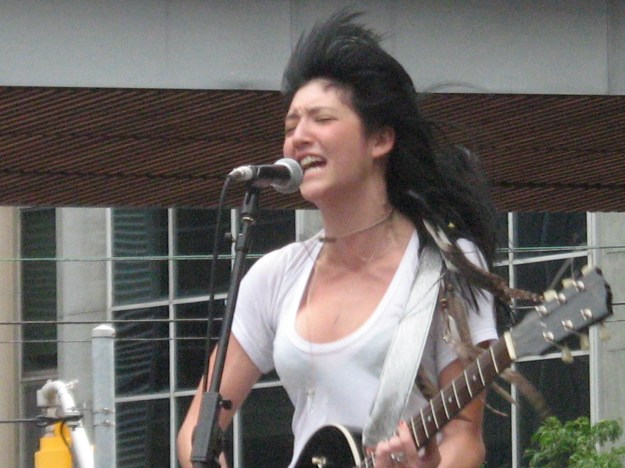
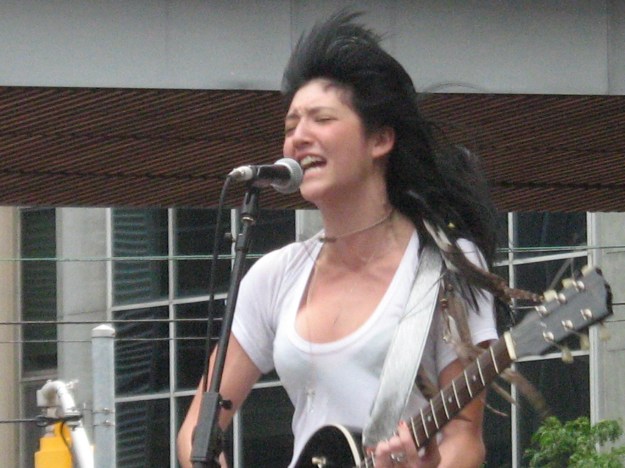
Queen Kwong live at Yonge-Dundas Square on June 19, 2010

Queen Kwong live at Yonge-Dundas Square on June 19, 2010

The photo pit was packed for Queen Kwong’s set, which was good planning on the media’s part, because Carré Callaway gave them all she had. At points it was as if the photographers were hypnotized by Callaway’s hair.   I can only imagine how many close-ups were taken of her screaming into the air, her hair dancing chaotically around her head in throes of passion – if there was an insect or any other entity within a two-foot radius of her head, it better have feared for life.  If she couldn’t exterminate such pests with her hair, she probably could have done it with her voice.  Even away from the mic she could carry sound; it was as though she had a megaphone implanted in her throat.  One fan in particular displayed his appreciation for Queen Kwong’s set when Callaway told the crowd the band was going to play a couple more.  Out of the mass he shouted, “How about a couple three?” to which Callaway laughed and said “A couple three?  Ok I think we can do that…”

Next up was De Staat.  By then the clouds had parted and the sun had come out as if with the combination of the Burning Boyz and Queen Kwong’s set, NXNE’s free concert had earned the approval of Mother Nature.  Within one song, I thought, if Christopher Walken makes a trip to Holland, De Staat is the band he’s going to want to see; with more cowbell than the Blue Öyster Cult could ever offer, they sounded the way Queens of the Stone Age would if they were injected with some fulltime electronic effects, Josh Homme got a deeper voice and in his singing became consistently cheerier and more enthusiastic about his lyrical subject matter.
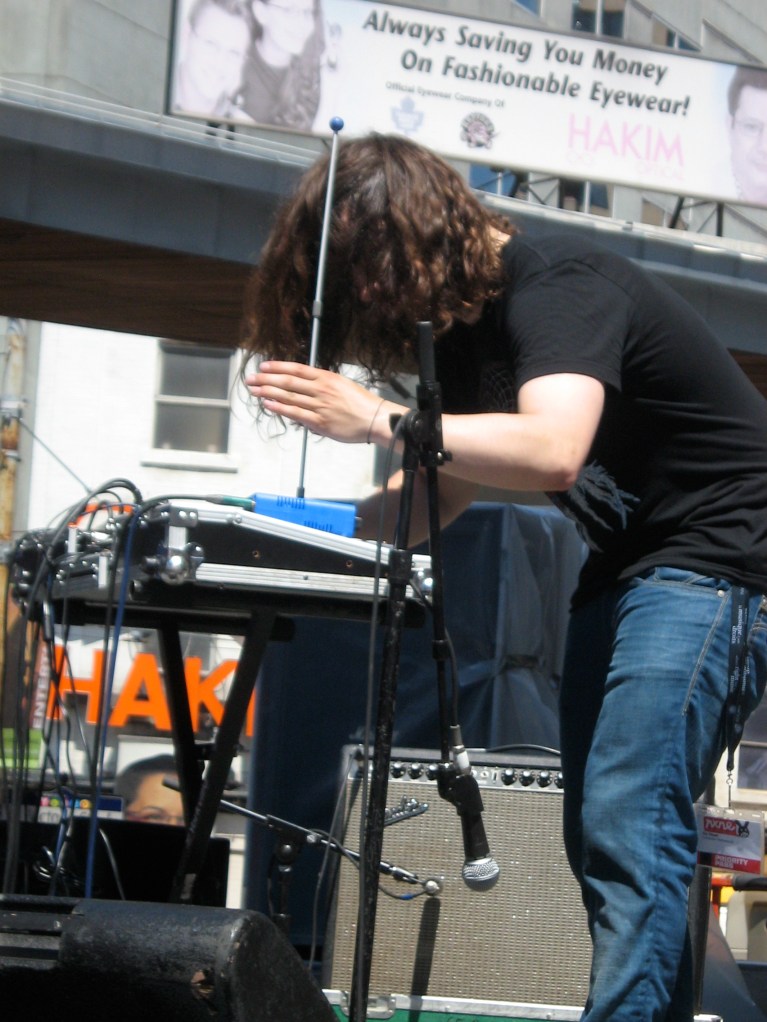
De Staat live at Yonge-Dundas Square on June 19, 2010

De Staat live at Yonge-Dundas Square on June 19, 2010

When multi-instrumentalist Rocco Bell broke out a theremin, the small crowd that surrounded the stage for this treasure from Holland seemed entranced, as if dominated by the influence of foreign sorcery. To be sure, for anyone unaware of the theremin’s existence, its presence instantly becomes an object for fascination. It involves no physical touch, emitting sound based both on the user’s hands’ proximity from the base of a vertical rod and from the rod itself.  Employing it like a secret weapon, Bell waited to break out that toy until the last song, and it stole the audience’s captivation for the remainder of De Staat’s set.

After De Staat’s set, I made my way over to Queen Kwong’s merch booth and set up an interview with Calloway, which we did five minutes later across the street in O’Keefe Lane.  Right towards the end of our conversation, Mini Mansions had started their set, so when our conversation was over I headed back to the stage.
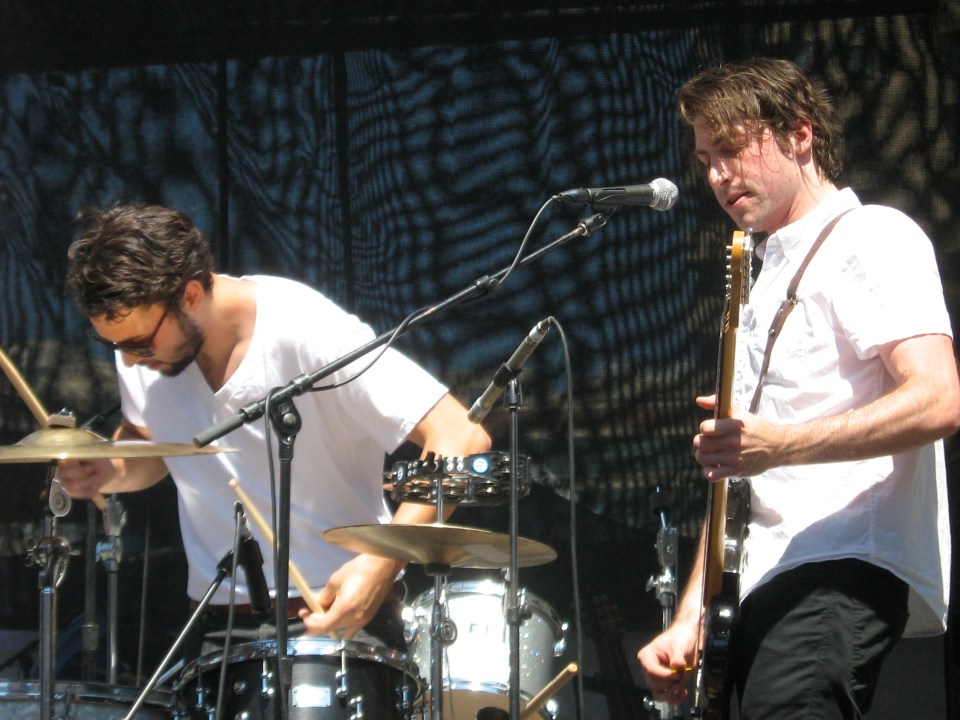
Mini Mansions live at Yonge-Dundas Square on June 19, 2010

Mini Mansions live at Yonge-Dundas Square on June 19, 2010

A trio of instrument flip-floppers that always kept their auxiliary tools close at hand (and sometimes right on their backs), Mini Mansions is a band that weirds you out like you just witnessed a surrealist car crash and makes you move your head to every peculiarity of their sound (and there are a lot).  As if in an act of sonic anesthetization, Michael Shuman would paralyze the crowd with a psychedelic guitar introduction and then carry the rest of a song standing up, playing a minimalist drum-kit that prompted partnered dancing and a swaying mass. For me, their re-imagination of Blondie’s “Heart of Glass” was like a synesthetic tie-dying of the original hit. I felt like I was on a checker boarded New Wave island surrounded in every direction by an ocean of ever-changing colours, waves brushed with the vibrancy of 1979.

When they were done, I left Yonge and Dundas Square to find a washroom across the street in the Eaton Centre.  It’s not a place I frequent on my trips to Toronto, but since I didn’t see any Johnny-on-the-spots I went there and tried my luck with the consumer-friendly Sistine Chapel. This “minor” detour made me late for The Soft Pack.

When I finally made it back, I found that a large portion of the crowd – which earlier in the day had cowered at the cloud coverage – had taken to seeking shade in the square and finding a good place to sit down and lay back while The Soft Pack did their thing. By then it was past four o’clock, and feeling four hours of standing was a lot, I joined in this practice.  Not much of a stage theatrics band, I felt like this would suffice anyway.  I coveted the back supporting chairs and umbrella shaded comfort of the seating in the beer gardens to the left of the stage, but not willing to pay ten bucks a drink, I avoided that awkward conversation and sat on the ground.  There was still some sway-dancing going on in the small crowd in front of the stage, but I felt like this band was perfect for situations like my own.  The Soft Pack is chill out music, the kind of thing you want a lawn chair and a cooler to enjoy properly.
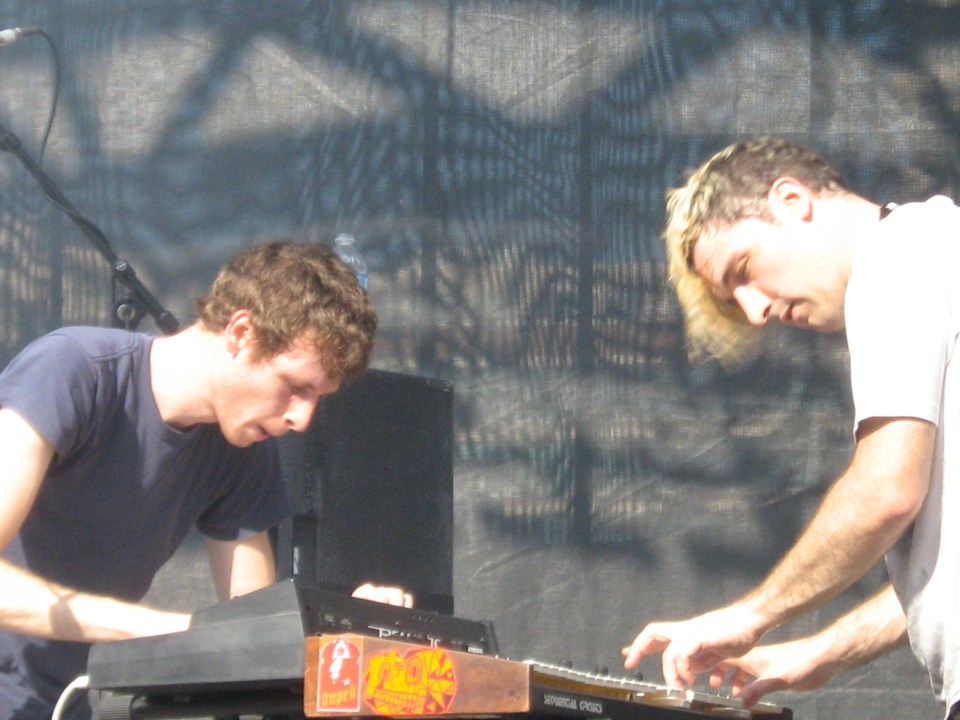
DD/MM/YYYY live at Yonge-Dundas Square on June 19, 2010

DD/MM/YYYY live at Yonge-Dundas Square on June 19, 2010

Eventually The Soft Pack got off the stage – maybe a little bitter about the crowd response – and DD/MM/YYYY got on.  The crowd for this band was a head bobbing and foot stomping horde, feet pounding the ground weirdly in sync with a sound that made you feel like you were in some avant-garde space station of an entirely different galaxy.  With dual drummers and keyboard technicians that played opposite one another, I felt like the performance I was watching was more a struggle between band members to communicate with each other than a concert – members engaged in a kind of tribal sound-speak that involved shouting one syllable at a time while methodically hammering their respected instruments.

Surfer Blood came on and the crowd got back into a sway-dancing fix.  DD/MM/YYYY interrupted that with their more spontaneous sound, but I was convinced that whoever was in the ranks for Mini Mansions and The Soft Pack had made sure they stuck around to catch Surfer Blood on time; rocking back and forth was not an option, but a way of life for these people – they were born to sway, and Surfer Blood would know it!
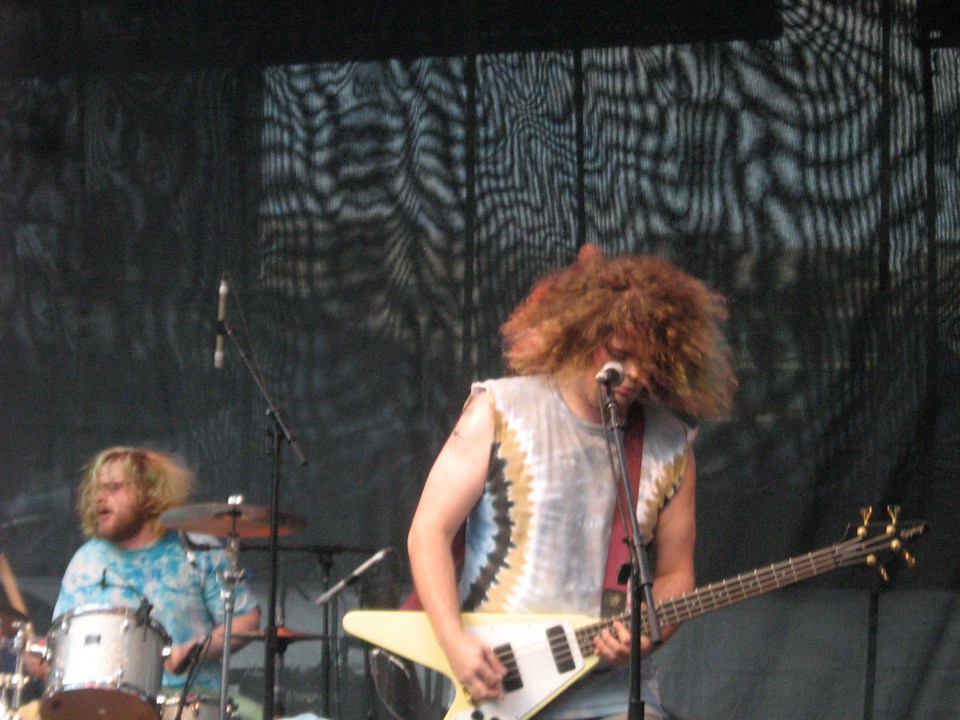
Wavves live at Yonge-Dundas Square on June 19, 2010

Wavves live at Yonge-Dundas Square on June 19, 2010

Next up was Wavves.  Fucked Up’s Damian “Pink Eyes” Abraham introduced these guys after Surfer Blood’s set, saying that the second “v” stood for “voluptuous,” and if you are of the opinion that time is money, you would have agreed with him.  These guys seemed rich on time – that is, they were certainly in no rush to get off the stage – perhaps in no rush to do anything.

Quoting Pauly Shore one-liners between every song, I could feel the patience of the crowd evaporating – with crowd numbers growing at an exponential rate, it was getting to be quite the mob. I should say here that I have no qualms with the great and powerful Shore, but if you’re a stoner surf-punk band that happens to be opening for a band like The Stooges and you try to steal the show, even the most drug addled and sun drunk crowd member will be on the verge of endorsing the same level of maturity and authority as the clerks in the convenience store scene of Encino Man.

In modern times, perhaps it was their perpetuation of the lazy, spaced out stoner stereotype that earned them the indignant crowd they faced.  Either way, with songs that made you feel the way you do on joy rides, I was having trouble understanding why they didn’t stick to their music—such a commitment alone could have sustained a friendly crowd. C’est la vie.
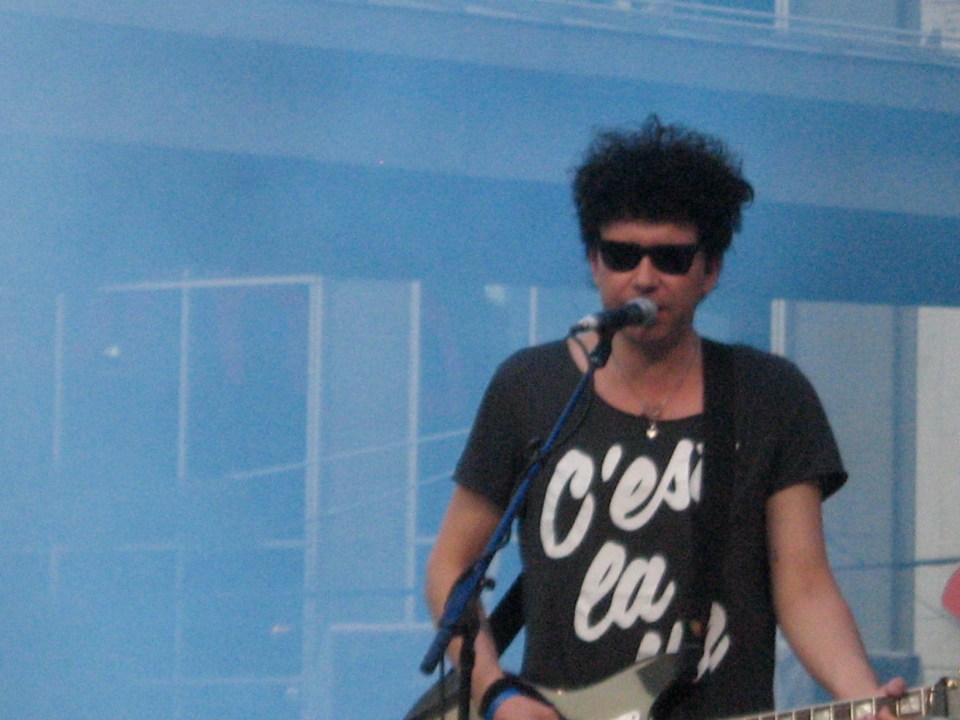
The Raveonettes live at Yonge-Dundas Square on June 19, 2010

The Raveonettes live at Yonge-Dundas Square on June 19, 2010

Between Wavves and The Raveonettes’s sets, it became very apparent that garage punks Sune Rose Wagner and Sharin Foo had made quite a name for themselves in Ontario’s capital, as the stage technicians were receiving hollers as they prepped the stage for the Danish duo.  That was confirmed when they got on stage with some extra stage presence (The Raveonettes often borrow help to deliver the sound they want to broadcast) and practically the entire square cheered to let the band know they’d been waiting.  While they combined elements of folk guitar and airy trance sounds or trip hop drum beats with Cure-reminiscent guitar and near-whispered lyrics, the crowd responded by making the atmosphere a little hazier, as a thick cloud of pot smoke meshed with the fog from the band’s fog machine in front of the stage.  When Wagner shot out a distorted guitar bend and the strobe lights responded I just closed my eyes and let the colours in my eyelids play with my mind. It was like driving down a highway in cottage country, the light making its way between the trees for the brief moments you spent passing it; delivering you to some completely different level of alertness.

With hundreds of late comers filtering in throughout The Raveonettes’ set and still more coming, once Pink Eyes got off the stage, saying farewell to the crowd presumably to find himself some space to watch the band from and the bumper music initiated, premature mosh pits ensued.

This is the part of the night where you take your wallet from your back pocket and stuff it far down one in the front.  You trust no one, and try your damnedest to hold your ground.  About six rows of people from the barrier in a crowd of thousands, I was playing a game where I had my territory—meager as it was—and I wasn’t going to give it up, no matter how much another person might have felt they deserved it.  This one guy, he got his right leg in front of my left one, trying to wedge his way in front of me from behind me to the left.  You just make these people feel awkward, and they leave you alone. I didn’t look at him ­– he kept trying for about a minute and I just kept all other possible entry points covered – and then he stopped, extracting his leg probably the most miserably lame experience he’d had in a long time.

Iggy and the Stooges live at Yonge-Dundas Square on June 19, 2010

Iggy and the Stooges live at Yonge-Dundas Square on June 19, 2010

Only into the first song of the night, at the climax of “Raw Power,” Iggy leaned over the crowd right in front of the barrier.  I was still pretty close at this point, and I could have taken a decent picture if it weren’t for the tempest-like conditions of the pit.

It’s hard to imagine finding anyone you know when you’re in the heart of Toronto’s biggest mosh pit in forty years, but within only two songs I had run into four old friends – some of them people I’ve known since elementary school.  These interactions were short, and they all went the same: we grabbed one another by the shoulders, shaking each other like we’d met in some old war, yelling out opposing names and then “Iggy Pop!” and as if satisfied with each other’s upbringings and consequential musical bents, parted – within seconds engulfed by the beast that was the pit.

After “Cock In My Pocket” – The Stooges’ fifth song of the night – Iggy took a break to address the crowd.  “Now… now… now… I feel lonesome.  I want the entire crowd on the stage! Mathematically impossible, but through the power of emotion! You, you in front come here. Don’t worry about the bouncers, they’re cool. Come on. Come on, let… let ’em up. Come on, we need dancers… wild Canadians.  Do we have any wild Canadians in the wings? come on!”  And the band broke out into “Shake Appeal.”

If I have heard a better incitement of pandemonium, my memory certainly failed me then, as it does now.  When he said “Mathematically impossible,” he might as well have said “morally impossible.”

As far as I can tell, the only physically possible way for a human being to bypass a mass of fans in order to make it over a barrier and onto a stage is by way of Ye Olde Crowde Surfe.  The thing about crowd surfing is, it only works when there are people to keep the body afloat, and under normal conditions, it’s easy to find that leg-up that will get you above the crowd.  However, when The Stooges, various inebriants, and a three-minute song are all factors facing a sea of thousands who were just told to get on stage with the aforementioned godfathers of punk; the altruism of the concert-goer is hard to find: forget finding a leg up, let alone people with enough care to sustain your buoyancy.

I myself tried to get above the crowd, but I failed for the reason I have just described – there is not much reasoning to be had with a mob.

By the time “Shake Appeal” was over, there were about fifty fans making their way off of the stage. Iggy let them get off the stage and dove right into “1970.”

I stayed in the pit up until “Death Trip” and then I had to get out.  I’d seen a water fountain to the right of the stage earlier in the day and the only thing I wanted above Iggy Pop was water, so I went for it.  I was fully aware it might end up being a long wait, but when I got there I saw that there was no line and I took the time to fill up a water bottle.  “Death Trip” didn’t end much longer after, and then Iggy announced that the band would play a ballad, so when they got to playing “Open Up and Bleed” I continued my break from the pit.  When finished that song, the band got off the stage and I swore under my breath.  “These guys better play an encore” I thought, “there’s no way they end a show on a ballad.”  Sure enough, the crowd cheered, and they got their just desserts.

The Stooges played through “Loose,” “Fun House,” “No Sense of Crime,” and all the while the pit seeming completely revitalized.  But, having announced just before “No Fun” that the band would be playing its last song of the night, a whole new level of mayhem ensued.

“No Fun” was infamously covered by The Sex Pistols as their last song ever performed just before their breakup in 1978.  At the end of that performance, Johnny Rotten laughed at the crowd, saying “Ahaha, ever get the feeling you’ve been cheated? Good night!” but I have a hard time believing that anyone present for The Stooges’s own performance of the number left anyone feeling cheated.  I felt like everything had come full circle.

Iggy had the last words, “Well ladies and gentleman, and children of all ages: it’s been fun, it’s been real, and now: I gotta go get drunk!  So let’s hear you sing along with me…No fun!  No Fun!  No fun…”

Stooges Setlist:

Raw Power

Kill City

Search and Destroy

Gimme Danger

Cock In My Pocket

Shake Appeal

1970

Beyond the Law

I Got A Right

I Wanna Be Your Dog

Your Pretty Face Is Going to Hell

Death Trip

Open Up and Bleed

Encore:

Loose

Fun House

No Sense of Crime

No Fun


(Originally published by Truth Explosion Magazine on June 20, 2010)

Queen Kwong: “Fubar got addicted to Indian food”

Queen Kwong at YDS June 19, 2010

Queen Kwong performing on the free stage Yonge-Dundas Square, Toronto, ON June 19, 2010.

When I was renting a house with some other students a few years back, this street cat started showing up on our doorstep, every time with a new war wound from fighting neighbourhod animals.  This prompted my housemates to name him Spartacus.  He’d come, get screwed up on catnip, and leave.  In an effort of harm reduction, they eventually stopped letting him out of the house.

I always wondered if there was some kid leaning out a door dinging a dinner dish for Spartacus, but just before the start of winter break, Spartacus made a break, and this concern saw an end. Albeit, when my housemates and I returned for the winter semester – folk wisdom satisfied for the umpteenth time – the cat came back.

Hailing from Los Angeles, Queen Kwong’s multi-instrumentalist and feline empress Carré Callaway has experience with the opposite side of this kind of story. I got to talk to her after a set at NXNE and here’s what she had to say about life in cat kingdom.

Carré Callaway:  I have two cats.  One is a fat 25-pound cat named Bonzai, who’s a real scaredy-cat and the other one is a little tuxedo cat named Fubar, and Fubar’s really bad – so I have a fat cat and a bad cat.  There are so many stories.

Tom Beedham:  What kind of trouble do they get into?

CC:  They’re outdoor cats, and one time Fubar got addicted to Indian food.

TB:  Hahaha.  Curry junky.  So this is the bad one?

CC:   Yeah. The fat one thinks he’s a vegetarian.  I try to feed him leftover fish and all sorts of stuff but he will not eat it.  He likes salad with vinaigrette, and Pringles.  I mean he’s on a strict diet – I only give him Pringles once a year on his birthday.

TB:  Right on.  People say pets are a lot like their owners. Are your cats like you, personality-wise?

CC:  [Fubar] is like my crazy bad side, and [Bonzai] is like my domesticated, scaredy-cat side.  The fat one’s neurotic and really picky about what he does and I’m kind of like that, and the other one, Fubar, eats everything like I do and you know, he’s a total badass, so I like to think that they’ve both got a part of me, even though I didn’t give birth to them.

TB:  Alright.  So Fubar got addicted to Indian food.

CC:  Yeah.  He stopped coming home because he decided to move in with these Indians that lived down my street.  I didn’t see him for two weeks.

TB:  Was this normal?

CC:  He’d go into neighbours’ houses and eat the dog food; he’d sleep in their closets; he’d eat cereal and he knows how to open cupboards, so he’d open cupboards and eat cereal; I’d get calls from neighbours that were like, “your cat’s over here eating my cereal, ripping apart my paper towel and scaring my dog.”

TB: Were they pissed about this?

CC: They all thought he was cute.  Basically a mile radius around my house everyone knew who he was.  They called him “The Mayor.”

TB:  Royal treatment.

CC: Yeah.  So basically he disappeared for two weeks and I didn’t know where he was and I was freaking out.  And one night, I came home, and I saw these Indian people coming home down the alley from me and they were like “Fubar, Fubar, come on, time for dinner,” and I stopped and I said, “Fubar’s my cat!”  And I tried to grab Fubar and he ran from me – it was really heartbreaking for a second – and he ran from me, into their apartment, because they were feeding him curry and he was really into that.  He didn’t want to come with me and I grabbed him to take him home and he was screaming, he was like, “MRAAAWR, MRAAAWR.”

TB: Kind of like one of those really bad moments at the end of all those pet movies where the pet has to choose and it goes to the wrong person.

CC:  Yeah! But I’ve had him for seven years – they’d just been feeding him Indian food.

TB: Yeah, he was curry nipped.  Does he still get into this kind of trouble?

CC: I finally got him back and now we live in a loft, so I don’t allow him outside.  He’s domesticated.

TB: A happy ending.  I guess maybe bittersweet for Fubar.  Alright. I have one last question.  What is the “truth” about Carré Callaway?

CC:  The truth about me is, I’m addicted to true crime documentary shows.


(Interview originally published by Truth Explosion Magazine on June 20, 2010)

Concert review: The Misfits @ The Opera House, June 17th 2010 in Toronto, Ontario

An anti-nativity

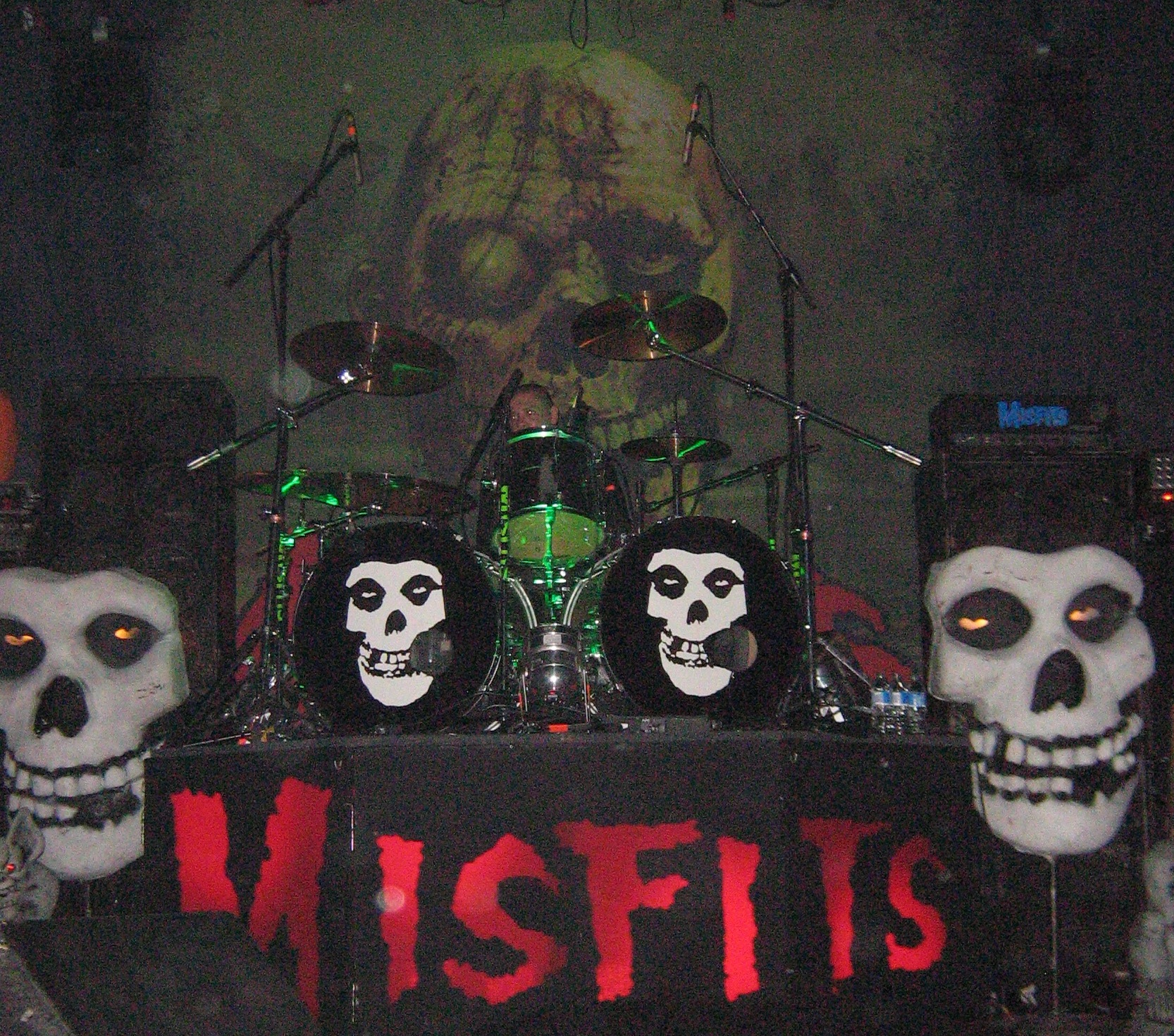
The Misfits played Toronto's Opera House June 17.

The Misfits played Toronto’s Opera House June 17.

“Have fun at Black Flag.”

This is what one of two guys said tongue-in-cheek, getting off the GO bus just before the Brampton station, where I make the transfer to get to Union.  That’s after I ask if he and the friend sitting next to him are going to The Misfits.  A simple “no” would have sufficed, but he was taking the piss.

These are people I went to high school with – friends of friends.

The guy who was sitting next to tongue-in-cheek guy tilted his head back and laughed.  They were on the same wavelength, and it was the last jab they could get in before they were off and on to other things.

I have no illusions about today’s Misfits – now one part original member Jerry Only on bass and lead vocals, and two parts Black Flag with Dez Cadena on guitar and Roberto “Robo” Valverde on drums – they’re far from their original lineup.  That said, I know well that the “Misfits are Black Flag” people aren’t right either.

I felt like stopping them in their tracks and mentioning how Robo played with the Misfits from 1982-1983 (a whole year in which original singer Glenn Danzig was still a member), or how it’s not even like he was an original Black Flag member – he was their third drummer. But it came down to a matter of time management since they’d already pressed the button to get off the bus and I just let them walk up the aisle, in my head thinking of things George Orwell said.

With the time the bus reached Brampton GO station, there was only a five-minute wait to make the transfer to get to Union.  The rest of the ride meant passing through suburbs and past a McDonald’s, outside of which I saw a lone gull pecking at some trash.  I remember thinking such mediocrity would be the best appetizer for preparing for an entrée of Misfits; it takes twice as long to get to the city from Georgetown to Toronto, but I recommend bus travel.

When I got off at Union, I had to get in contact with my editor to pick up my press pass for NXNE. The festival had already gotten underway, and the pass would get me into any of fifty venues for free, from then until Sunday (or far into Monday morning).  We met up just before Queen and Spadina, talked briefly, and went our separate ways. By then it was about quarter to 9 p.m., and I was supposed to be at The Opera House for nine to interview The Misfits.  I hailed the first empty cab I saw, and it was a long ride that felt as though it was being ever-perpetuated by streetcars breaking for passengers and hateful stoplights.

When I got to the venue it was nine o’clock on the nose.  I gave them my name and affiliations, telling them I was supposed to interview the band, and they checked the guest list and sent me in.

The first opener was already on, playing poor covers of songs like the Dead Kennedys’s “Moon Over Marin,” and as if because of their novice, tall cans of Canadian seemed to float around the Opera House as though pulling their coddlers without direction, bringing individuals to stand awkwardly in front of people, only to snap back into reality and be towed by their brews to some unplanned destination, over and over again.  In majority, it was a crowd of lone punks.  I could tell that these people didn’t travel in packs—they were the few that left their respected groups for the evening to get a taste of iconography.

I went straight to the merch table, and made an inquiry as to where to go, and the merch-guy spoke – or yelled – of a van I was supposed to find out on the street.  I headed back to the doors and asked about this, and the same person who I had told what I was there for said there was no reentry. I can understand this concept, but when media are involved, I am slightly baffled. I had told my editor I would do the interview and write this review, and I wasn’t about to take a chance that might deny me both of these options. I was also irked that they didn’t tell me this before I went in the doors, after I had told them why I was there. Broken and not in the position to gamble, I went back in the club and watched the rest of the bad covers the openers poured out.

When Bastard Child Death Cult came on, it averted the crowd’s attention from the tall cans, and within the first song they played, the horseshoe of boredom around the stage collapsed into a thrash pit of admirable size for an opener.  They did their thing, got the crowd anxious and angsty, threw a shirt, and left the stage.

Thirsty punks ambled up to the bar to get more white bullets, and I was able to make my way up to the barrier in front of the stage to pick a nice patch of steel to get comfy with.

After a few bumper tracks, the man that made this iteration of the Misfits worth seeing himself poked out from stage left: arm straps, spiked leather vest, devilock, eye shadow and all.  The crowd met this taunt with cheers, and the mass surrounding me took up a cheer that was like a punk rendition of the Jerry Springer chorus, with fans shouting “Jerry!  Jerry!” ad nauseam, complete with intermittent hollers and screams.  I could see Only cackle for a brief moment, and as if absorbing the energy, with knees bent he shook his fists while his arms were bent in some B movie or video game power up moment, wrists pointed to the ceiling and biceps bulging.  He made himself known and hid away.

When the bumper music ended, the keys for the theme from Halloween dominated the club and there was a burst of cheering from all around.  Stage monkeys made their way on stage and got to work at dissembling a cloaked scaffold.  I wondered what kind of set up would be revealed when they were done, and in less than thirty seconds, I found out.

Like an anti-nativity, it was a scene strewn with jack-o-lanterns, gargoyles, numerous manifestations of the Misfits fiend skull, and mic stands complete with macabre vines of apparently rotting flesh snaking their way up to moldy skulls that were like the hives of doomed colonies which by some freak coincidence had managed to prevail throughout the test of time. Behind the drum kit hung the ominous image of a skull that was half the original fiend skull, half something else – something alive, or undead.

When Only came on stage, there was the shrunken head of a cyclops with a horn growing out of its forehead fitted to where the tuning pegs should be on his bass neck.  I could only intuit that some demon was the maestro that had prepared his sound for the night.

When the Halloween theme ended, the Misfits detonated their own ode to October 31st: “Halloween” exploded, and so did the pit.

It was a presence as well executed as the set of a film made by George Romero. I was in Night of the Living Dead. I was in Creepshow.

Pressed against the barrier by the weight of ’Fits fans young and ancient, I thought how if any band could channel zest back into the unsettled perished and raise the undead, it could be the Misfits.  In a moment of euphoria-induced fantasy I toyed with the idea of a zombie wake and the need for an escape plan.  I thought of my slow cab ride to the Opera House and how running down Queen St. probably would have been faster; how far away Pearson International is. I wonder if I could make it to the docks and catch a ferry to Toronto Island and track down a pilot with the unlikely willingness to accept a bizarre horror story about a band that raised the dead – the movies have shown that zombies can swim, but I have my doubts about their flight capabilities.

I thought how the City of Toronto was prepping for the commencing of the G20 on Sunday, and how a Mars Attack or a zombie invasion a few days prior would throw off any security force in Toronto, or any protestor for that matter.  But in the presence of this band, I felt at ease.  I just sang along.

(Originally published by Truth Explosion Magazine on June 18, 2010)

New NXNE takes over Toronto

Music festival is bigger and better than ever before

16 June 2010


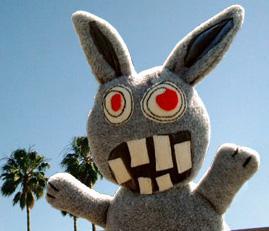
Sketchy, the unofficial mascot for NXNE has travelled far and wide to promote Toronto's ever-changing music festival. (Courtesy)

Sketchy, the unofficial mascot for NXNE has travelled far and wide to promote Toronto’s ever-changing music festival. (Courtesy)

Since 2005, pictures of Sketchy, an androgynous – and apparently dead – rabbit have blanketed Toronto’s telephone poles and flyer-bombed concert hall walls and other cluttered surfaces. This year, Sketchy’s twisted visage has leapt from the confines of two dimensions into clubs, parks and Yonge-Dundas Square; as usual, he’s here to let people know the annual North by Northeast (NXNE) festival is back.

Sketchy is a mere five years young, but the event behind the unofficial mascot is a little further on in its years. Birthed in 1994, NXNE has brought together local acts from the GTA, Canada and other countries for 16 years. The festival can also take credit for unifying the efforts of 50 typically competitive concert venues.

This year’s musical bricolage consists of about 650 musical acts, up 400 from the year of its inception. The performers range from folk troubadour solo artists to post-punk dance dub groups and beyond; they include acts from Eagles of Death Metal, Sloan, Hawksley Workman, Attack in Black and PS I Love You.

2010’s NXNE will also include a massive free concert headlined by music legends Iggy and The Stooges on June 19 at Yonge-Dundas Square. Yonge Street will be shut down for the festival, something that NXNE managing director, cofounder and co-owner Andy McLean says will make the event “arguably the largest downtown city concert the city’s seen.”

The Stooges have endured a bandmate’s death, the comings and goings of several members, a breakup, several hiatuses, personal demons (including lead singer Iggy Pop’s heroin addiction) and a coup against the sound David Bowie gave them on the album Raw Power.

And like The Stooges’ lineup, NXNE has seen ongoing changes.

“It’s not like you just churn it out,” McLean insisted. “It’s custom-built every year.”

But while McLean ensures NXNE-goers that this year will be no carbon-copy of last year’s festival – he promises you’ll see 500 brand new and emerging bands there – he isn’t just talking about the artists.

NXNE’s technology has also developed over the years.

For musicians, said McLean, “everything’s done digitally, by email, uploaded here [at NXNE headquarters].” The NXNE website has become the main interface as the festival has adapted to the information age with a Facebook group and Twitter feeds, as well as two new mobile apps developed for the iPhone and Blackberry in order to help keep fans in the know on the go.

While the technology has changed for McLean, the industry he gets his talent from has gone through a metamorphosis of its own. But what McLean is determined to preserve is the experience of seeing bands up close and personal.

“You can cruise the Internet looking for bands,” said McLean. “But I think still going out and feeling that kick drum in your chest when you walk into a club – you’ll never replace that by going online.”

In order to perpetuate the band-audience exchange, McLean and people like Michael Hollett and Yvonne Matsell have put together workshops, conferences and interactive sessions headed by speakers like Alan Cross and Ze Frank. Here, musicians can learn about how to make money playing music, gather networking skills, meet with media and more.

Now that it’s time to unleash the musicians, NXNE is paying dues by throwing a festival of epic proportions, having opening night parties at the CN Tower, The Phoenix, The Courthouse and The Mod Club. And with many participating NXNE venues serving drinks until 4 a.m. throughout the rest of the week – a NXNE tradition fresh from last year – it will be a long and electrifying haul until the festival’s close on Sunday.
(Originally published by Excalibur on June 16, 2010)

Protest the Hero’s Dostoevsky grin

Math-metal quintet hits The Brass Taps 

Protest the Hero (Courtesy)

(Courtesy)

Long before MuchMusic’s disBand and before Lights and Stereos were signed to his record label, in 1999, Mark “London” Spicoluk’s Underground Operations was but a small nexus that consisted of a fistful bands that you only knew about from word of mouth, hours spent on Myspace, or from watching George Stroumboulopoulos’ The Punk Show.  While many of the bands that originally supported Spicoluk’s label have since left to pursue other things in life and the face of Underground Operations has certainly changed, one group has only changed its name.  Once known as Happy Go Lucky, Whitby mathcore act Protest the Hero maintains its association with Underground Operations still to this day, despite having gained worldly success and being signed on to the monolithic Vagrant records since 2006.

In an execution of reifying their contemporary name, last Thursday Protest the Hero took a night off from their freshly embarked upon Jagermeister-sponsored and more commercially attractive Snocore tour to headline an intimate, 350-person capacity show put on by the University of Guelph’s metal club at The Brass Taps.

Assaulting fans with an arsenal of songs mainly from their 2008 studio album Fortress, but also including tracks like “Blindfolds Aside” and “Divinity Within” off of their 2005 album Kezia – which combined with a 2006 signing to Vagrant records also brought the band success in the States – Protest unleashed a performance that went against what lead vocalist Rody Walker anticipated about the band at the time of Fortress’ release.  In a 2008 interview with MTV, Walker described Protest the Hero as ADD metal, making reference to how the band gets bored easily and how at the time of Fortress’s release, there wasn’t any desire to play songs off of Kezia ever again because the songs were routine and they wanted to perfect their new and more complicated work.  Bassist and lyricist Arif Mirabdolbaghi confirms that when PTH plays tracks from Kezia, it’s mostly for the fans, but also maintains that when Rody did that interview, his responses were indicative of “a time in [the band’s] life where we were feeling this sort of musical frustration.”

The band’s reverence for undertaking onerous tasks might have something to do with its influences.  One of Protest’s most overt lyrical influences – especially in pre-Kezia material – is Russian novelist Fyodor Dostoevsky.  Even the title of one of PTH’s songs, “I Am Dmitri Karamazov and the World is My Father” is a direct reference to The Brothers Karamazov, Dostoevsky’s last novel, which is – in only a few words – about struggling with intellectual stasis.

In 2004, Mirabdolbaghi was even invited to (and attended) the 12th Symposium of the International Dostoevsky Society at the University of Geneva in Switzerland.  Reflecting on the Russian thinker, Mirabdolbaghi admires the fact that “[Dostoevsky’s] mind rebels stagnation” while also contending that there is no way he could ever cease to be influenced by him, even while “perpetually turning into someone else.”

Despite the band’s self-acknowledged short attention span and while tens of thousands of students prostrate the fruits of their hard-earned labour to the university every semester, bassist and lyricist Arif Mirabdolbaghi said that even though the band has made some obscure rider requests in the past – including birthday cakes, underwear, wallpaper imported from China, Persian carpets, and films by Dennis Quaid “because we think he’s a comic genius, even if he doesn’t realize it” ­– on Thursday Protest played it modest and didn’t ask for anything special to play at the U of G. Mirabdolbaghi also insisted that, “Our rider isn’t ‘make it or break it’ in the sense that if we don’t receive what we request we’re not going to play a show.”

According to Mirabdolbaghi, after Snocore and an appearance at New Jersey music festival “The Bamboozle” at the start of May, the band ­– which hasn’t put out any new material as far as songs go since Fortress in 2008 – is looking forward to getting back into the studio and recording new work, which they’ve already started writing.  Apart from his work with Protest the Hero, Mirabdolbaghi is further pursuing his interest in Dostoevsky.  In collaboration with an actor friend, Mirabdolbaghi is currently in the process of interpreting a Dostoevsky work for a string bass piece, the performance of which will premiere in Toronto at the end of April.

(Originally published in The Ontarion on April 1, 2010)

From teenage Sex Pistol to folk troubadour

Glen Matlock in the Royal City


Former Sex Pistol Glen Matlock (Courtesy image)

(Courtesy)

Approaching the Guelph Youth Music Centre (GYMC) on Feb. 5, considerable mystery surrounded what the evening’s events would entail. Advertising for the show could have been described as minimal at best (consisting mostly of a few flyers in Downtown Guelph shop windows), and the GYMC – in all the glory of its theater-like seating – isn’t exactly the quintessential punk haunt.  Smokers aired their own concerns and gave their forecasts as they shuffled cold feet in the snow outside the entrance, chewing over whether there would be a bar.

“There’s gotta be.  It’s Glen Matlock.  He’s a Sex Pistol fer chrissake!”

Glen Matlock has a special place in Sex Pistols history.  As the bassist for London’s seminal punk band, Matlock wrote most of the songs on Never Mind the Bollocks, Here’s the Sex Pistols, but punklore has it that he was excommunicated from the Pistols in 1977 for liking The Beatles too much.

The truth, as Matlock tells it in his autobiographical I Was a Teenage Sex Pistol, is that he left because he was “sick of all the bullshit.”  Whether or not that “bullshit” had anything to do with guitarist Steve Jones’s frustration over Matlock’s insistence that he learn Beatles chords for Never Mind the Bollocks, Here’s the Sex Pistols will be debated for as long as the Sex Pistols remain punk canon.

Making his way up to the same kitchenette counter open to everyone else in the GYMC lobby, no one recognized Matlock as the mere footnote in punk rock history that he has been reduced to by some storytellers.  All were aware that Matlock is the man who begat a new sound, and the bassist who could actually play it.

With psychedelic country rock band The Sadies opening, there was not an electric bass in the building.  Sadies bassist Sean Dean plays an upright acoustic, but that dids more than keep the beat; it served as a subtle but downright reminder that this is not 1976, and that this would not be the same act as could be expected at an early Sex Pistols gig.  No one was dressed in robes straight out of anywhere like Malcolm McLaren’s clothing boutique; there were no ragged fishnet shirts, no bondage belts jingling among the mass, and leather – if present – was brown and well kept, not tattered and black with haphazard stud jobs.  Perhaps this was a crowd that grew up and beyond the unforgiving nature of Johnny Rotten, much like the man they had come to see.

When Matlock was done his sound check, a lone bagpiper blasted into the room erupting into a rendition of Queen’s “We Will Rock You.”  Fusing folk method with a classic rock anthem, it was the perfect harbinger for what was about to come.

Matlock’s acoustic show proved that music doesn’t have to be vicious to be punk.    Making a point about punk aesthetic in an interview with Max Chambers, he pointed out that, “People talk about punk as a musical style, but also there’s a spirit involved in it.”

He cranked out Sex Pistols songs like “Pretty Vacant,” “God Save the Queen” and Tommy Boyce and Bobby Hart’s “(I’m Not Your) Steppin’ Stone” – a cover that every Sex Pistol (even Matlock’s bass incompetent-yet crowd pleasing Sex Pistols successor Sid Vicious covered it during his brief solo career) can say they’ve spent some time with – to an accepting crowd that sang along, and he had no problem disciplining the audience for their lack of familiarity with the chorus to Small Faces’s “All or Nothing,” looping the chords ad nauseam and saying “I can do this all night,” sitting back on the Sadies’s bass drum to further his point until he got the response he wanted.

Despite the demanding nature he took on during “All or Nothing,” Matlock was anything but arrogant; he was cheeky, but humble.

Matlock’s proved he’s above his Sex Pistols celebrity even when he’s not playing the role of traveling troubadour.  In response to Haiti’s earthquake in January he teamed up with Nick Cave, Johnny Depp, Bobby Gillespie (Primal Scream), Mick Jones (The Clash), and Shane MacGowan (The Pogues) to cover Screamin’ Jay Hawkins’s “I Put a Spell On You,” which is set for release later this month.

(Originally published Feb. 11, 2010 in The Ontarion)