Tag Archives: Toronto

Concert review: Chelsea Light Moving and Speedy Ortiz @Horseshoe Tavern | Sept. 15, 2013

Angular, avant-aggro guitar explorations take centre stage as Thurston Moore showcases new material and reimagines older songs at the Horseshoe

Thurston Moore breaking out text from John Donne for Chelsea Light Moving's reworking of the 16th-century poet's "The Ecstasy." Photo: Tom Beedham

Thurston Moore breaking out text from John Donne for Chelsea Light Moving’s reworking of the 16th-century poet’s “The Ecstasy.” Photo: Tom Beedham

“We’re the Ghetto Priests from Nova Scotia. It’s nice to be back,” quipped Thurston Moore about 25 minutes through Chelsea Light Moving’s set. Towering over the crowd from atop just the modest stage at the back of the Horseshoe, it was the first time the Sonic Youth founder had acknowledged the Toronto audience directly that night. But with a strap reading “THURSTON” cradling the forest green Jazzmaster that Fender hot-rodded out in its wearer’s name – as if appearance was the only thing fans could go on – there was no question as to who was standing before them. The guitarist’s presence is not the kind to escape recognition; even when he hung back at stage left to concentrate on assaulting his amp with a load of feedback, Moore’s situation at the Horseshoe was undeniable, especially with his new band.

Whereas Sonic Youth offered listeners a dialogical sound democracy of which Thurston Moore was just one of four loud voices, Chelsea Light Moving is a puppet (albeit a dynamic, multi-brained one) under Moore’s guitar testing hand, and the live show made that resonate with a roaring ferocity.

Chugging through a set filled with songs culled from the group’s eponymous debut, as well as new tracks “Sunday Stage,” “No Go” – apparently the “theme song” to a new board game to “be made from wood, plastic, and meat” that the band is working on “since nobody buys records anymore,” if you take Moore’s word for it – and an interpretation of 16th-century poet John Donne’s “The Ecstasy,” (full setlist below) the band’s set was heavy on noise improv, but all under the directive gaze of its most famous member. Even when guitarist Keith Wood was slashing away with picks that struck below the bridge, above the nut, and anywhere else that could render sounds from his own Jazzmaster, it was while awaiting nods and “1, 2, 3”s from Moore.

When the time came and the crowd collectively clapped for an encore, whether intentionally or not, one fan articulated their leader’s surname into a double-entendre, incessantly screaming “Moore!” (or “More!”). This continued until the icon ducked through the steps and back up to the stage to answer the supporter with, well, more Moore – and not exactly the Chelsea Light Moving kind; with CLM bassist Samara Lubelski switching to her violin (an instrument she was called to play on Moore’s Demolished Thoughts), the band’s encore performance was focused exclusively on churning out extended jams of “Staring Statues” and “Ono Soul” from their leader’s ’95 solo effort, Psychic Hearts.

Moore fans who arrived early for Speedy Ortiz (if unaware of the 2013 alt-rock breakout act) got a surprise double dose of noisy, angular guitar exploration, and one that was notably disparate to the Northampton, Mass. band’s debut LP, Major Arcana in terms of the mix, with guitarist Matt Robidoux seemingly turned up to 11 and getting as much attention as Speedy Ortiz founder and frontwoman Sadie Dupuis. Sourcing a stack of cassettes gifted to him at the venue, the guitarist found a toy to slide across his strings when he wasn’t shaking his guitar in front of an amp or plowing away at it for the noise pop outfit’s signature rhythms. After his strap failed multiple times throughout the set, Robidoux said something to Dupuis and it was time to announce the last song after just 20 minutes of set, but at least the crowd got a chance to hear Speedy Ortiz’s sludgy slacker anthem “Tiger Tank.”

Chelsea Light Moving setlist
“Groovy & Linda”
“Empires Of Time”
“Sleeping Where I Fall”
“Alighted”
“Frank O’Hara Hit”
“Sunday Stage”
“Lip”
“The Ecstasy” (John Donne)
“No Go”
“Burroughs”
Encore:
“Staring Statues” and “Ono Soul” from Thurston’s Psychic Hearts

You might also like this:


Concert review: Savages @ Opera House in Toronto | Sept. 12, 2013

Post-punk quartet Savages perform unreleased material, feature Duke Garwood onstage at Opera House

Album artwork from 'Silence Yourself,' the debut LP from Savages. Savages performed material mostly from this release at its Sept. 12 Toronto performance, but also showcased some newer, unreleased songs.

Album artwork from ‘Silence Yourself,’ the debut LP from Savages. Savages performed material mostly from this release at its Sept. 12 Toronto performance, but also showcased some newer, unreleased songs.

While post-punk quartet Savages played a Toronto gig at the Mod Club just back in July, when the London, England band’s fall tour made a stop at the Opera House Sept. 12, it proved it was up to more than clinging to the opportunity provided by a critically lauded debut LP.

To wit, the band’s solitary full-length, Silence Yourself, accounted for the majority of the band’s set, and to no profound surprise. They opened with “I Am Here” and its My Bloody Valentine-reminiscent noise intro, followed by consistently arresting performances of chilling tracks like “City’s Full” and “Shut Up” (full setlist below).

But Savages also used the occasion as a vehicle for planting the seeds of some newer, yet-to-be released material – and with it some sonic forays the band has been pursuing.

First there was “I Need Something New,” that was led by Fay Milton beating an entrancing war pattern into her kick and tom drums while guitarist Gemma Thompson let some notes stretch out into what (with the help of a delay pedal) seemed like infinity. When singer Jenny Beth lent her voice to the mix, it was to give articulation to what came across as spoken word. Then Milton started involving her cymbals, crashing the song to its climax as Beth screamed a line that was first repeated several times, then poetically deconstructed and (in a move that was both artistically and logically clever) developed into the song’s titlesake. All along the way it was every bit as haunting as you’d expect from them.

The band also injected some rarities into the mix: “Give Me A Gun” from the I Am Here EP, and “Husbands” B-side “Flying to Berlin” – the latter introduced by singer Jenny Beth as “a song to turn you on.”

They closed the set proper with another new one: a track that Beth has called “Fuckers” at previous performances. Prior to performing the track, Beth explained the song’s central refrain was inspired by a friend’s note left at her house:

“I have a friend – a very good friend of mine. He said, ‘don’t let the fuckers get you down.’ He came to my house, he left a note, and it said, ‘don’t let the fuckers get you down.’ I have good friends.”

After the band took bows and walked offstage only to have a techie rush over to their gear and check on tuning, where in the past the band has claimed aversion to encore performances, there was little question that one was going to happen at the Opera House.

When the quartet returned – in a move that you couldn’t really say was unexpected – they brought with them show opener Duke Garwood, carrying with him the clarinet he played earlier in the night to deliver the part he provided on Silence Yourself closer “Marshal Dear” as Beth tucked into a piano.

It wasn’t the only non-new material treat the audience got that evening: if they got there early enough, fans were able to catch Beth lend her own guest talents to the swirling closer that ended Garwood’s set of guitar, clarinet, and bass noise.

Savages were announced as shortlist contenders for presitious U.K. and Ireland music award the Barlcaycard Mercury Prize on Sept. 11. Let’s hope the increased exposure that comes with the nomination leads to some more news regarding their new material in the near future.

Savages setlist
“I Am Here”
“City’s Full”
“Shut Up”
“Give Me A Gun”
“I Need Something New”
“Strife”
“Waiting For A Sign”
“Flying To Berlin”
“She Will”
“No Face”
“Hit Me”
“Husbands”
“Fuckers”
Encore: “Marshal Dear” (feat. Duke Garwood on clarinet)

Weird Canada is getting behind cassettes in a big, $50K way

Canadian indie music website to use FACTOR grant to distribute music, champion technological accessibility

Cassettes overflow a KFC bucket display atop a table for Sonic Boom’s Cassette Fair held Sept. 7. The event was held in honour of the first annual international Cassette Store Day, where Weird Canada spoke of plans to feature cassette releases in its upcoming FACTOR grant-funded distribution service. Photo: Tom Beedham

Cassettes overflow a KFC bucket display atop a table for Sonic Boom’s Cassette Fair, held Sept. 7. The event was held in honour of the first annual international Cassette Store Day, where Weird Canada spoke of plans to feature cassette releases in its upcoming FACTOR grant-funded distribution service. Photo: Tom Beedham

On Sept. 7, a hefty serving of audiocassettes filled a KFC bucket to the point of overflow atop a table in the Annex location of Toronto record supermarket Sonic Boom. Ripe for consumption and low in calories, what’s been dismissed by some as a stale format for decades, the audio cassette has seen something of a revival amongst recording artists in recent years, this year prompting an inaugural, international celebration of the medium – labeled Cassette Store Day (hence the format’s prominent situation at Sonic Boom on the Saturday).

While Sonic Boom’s locations are most revered for the breadth of music they offer consumers through vinyl media, its Annex shop spent the day housing a “Cassette Fair” at the front of its store featuring offerings from cassette-release toting labels Arachnidiscs, Artificial, Awesome Tapes From Africa, Bennifer Editions, Burger, Buzz, Daps, Feather Hat Guy, Healing Power, Heretical Objects, Hosehead, Inyrkdisk, Kinnta, Mathematic Recordings, Medusa Editions, Not Unlike, Optical Sounds, Pansy Twist, Pleasence, Reel Cod, and Telephone Explosion.

Also tabling at the event were representatives of renowned indie music website Weird Canada, a publisher about to get behind cassettes in a big, $50,000 way.

After a stressful grant application process that had Weird Canada Executive Director Marie LeBlanc Flanagan up late writing (and rewriting) a proposal to the Foundation to Assist Canadian Talent on Records (FACTOR) on Valentine’s Day earlier this year, in the spring, Weird Canada was informed it would receive a $50,000 FACTOR grant to build an online store and distribution service.

“Basically what we’re going to try to do is connect record stores with bands, with fans, with labels, and send these cassettes all over Canada,” Flanagan told Burden of Salt while taking time out from speaking with consumers and those curious about the table she was working at the fair.

But why cassettes?

“Well, I feel that we as a culture, and our generation, really desire a physical medium,” said Flanagan. Speaking on the subject at a bustling record store, it was a suggestion that preached to the choir, but it didn’t yet clarify why people should be interested in what some now call an archaic recording medium.

Flanagan went on to explain that people should look to cassettes because they open doors for artists that other physical media cannot.

“We desire something physical that we can touch and collect and keep as a symbol of our music, but it’s really hard to release physical media,” Flanagan elucidated. “It’s expensive; it’s complicated; cassettes are the cheapest, easiest, actual physical, tangible media that we can access. The accessibility of technology means a lot.”

In deed, Weird Canada founder Aaron Levin has had some personal experience dealing with pressing records to vinyl.

“I put out a record and, yeah, it’s really expensive,” said Levin, leaning in front of Flanagan to get a word in. Levin also commented that the fallout from pursuing that particular physical medium can become intrusive. “When [records] don’t sell you have like 300lbs of stock that you have to live with.”

He calls cassettes “a very viable and accessible option for people who can’t release vinyl.”

Putting its money where its mouth is, Weird Canada will even roll out some cassette releases. After recording a Wyrd Fest showcase the publication threw at Toronto’s Music Gallery, the website has been granted release permissions from the venue to sell 100 cassettes of the concert, which featured performances from Jennifer Castle and Colin Bergh covering each others’ material, Zachary Fairbrother Feedback Guitar Orchestra, and Soul Sisters Supreme. They also have a project called The Weird Canada Releases, which will give rise to some cassettes.

While some have railed against the reemergence of cassettes as signaling cultural decay favouring an inferior recording medium and consumer exploitation, pointing to how less of the information recorded in a studio can be heard from cassettes when the medium is held against other formats like vinyl, Flanagan and Levin stand by the medium and say the “audiophile” argument is pushing a moot point.

“These cassettes aren’t taking away from records that would’ve been, they’re creating room for music to emerge that wouldn’t be without the cassette,” said LeBlanc. “This is a space in between for people that can’t [afford to] press a record.”

The argument also falls victim to deflation when it is brought up that most contemporary cassette releases come packaged with download cards linking the purchaser to digital recordings of the same music.

“But people don’t just want the download card, they want the cassette,” stressed LeBlanc. “They want the art and they want to touch it.”

“I think people want things to sound good, but most importantly they want the result of their creative expression to exist in the world and to be enjoyed by people. And tapes are right now the best format through which to do this,” said Levin.

Weird Canada’s distro is set to arrive in January 2014.

Concert review: Esmerine at The Great Hall with Matana Roberts, Saltland, Jerusalem In My Heart, and Dundasa 80 (Constellation Records showcase) at The Great Hall

Montréal label presents less exposed offerings to rapt audience

Esmerine performed at Constellation Records showcase at The Great Hall with four visiting members from Turkey, who helped them record their new album, 'Dalmak,' in Istanbul. Photo: Tom Beedham

Esmerine performed at Constellation Records’ label showcase Sept. 5 at The Great Hall, bringing in tow  four visiting musicians from Turkey, who helped them record their new album, ‘Dalmak,’ in Istanbul. Photo: Tom Beedham

“If all these things don’t make sense then just listen to the singing, alright?” Esmerine collaborator and current touring member Hakan Vreskala said after explaining the lyrics to “Yavri Yavri” as an articulation of a Hebrew relation regarding a bird that takes on the burden of crying others’ tears for them so that its own heart can become calm.

The disclaimer might not have demystified much for the audience gathered at The Great Hall for the headliner of the Toronto Constellation (CST) Records showcase, but Vreskala’s closing statement did convey a sentiment that seems to have been instrumental to the accomplishments of the label’s many experimental bands: who cares about satisfying what we think we know about music or instruments – let’s see what the stuff can do!

What began as Godspeed You! Black Emperor percussionist Bruce Cawdron and Set Fire To Flames cellist Beckie Foon’s cello-marimba duo, Montréal-based Esmerine pulled into Toronto Sept. 5 eight times the size of what it began as, having recruited Turkish collaborators Baran Asik, Ali Kazim Akdağ, James Hakan Dedeoğlu, and Vreskala himself after recording their recently released album, Dalmak, in Istanbul with the musicians, also having counted Jamie Thompson (Unicorns, Islands) and Brian Sanderson as members since early this decade.

The larger stage band helped the group deliver the sounds provided by the more exotic and numbered instruments heard on the new Esmerine album (they brought out a darbuka, an erbane, and a saz, among other things you’ll have to type into Google), but it also granted Esmerine the ability to perform some of its older material – they presented “A Dog River,” “Walking Through Mist,” and “Little Streams Make Big Rivers” from 2011’s La Lechuza (full setlist at bottom of review) – as new, fuller-sounding renditions.

With their set proper clocking in at less than an hour, the band did an admirable job adopting the headlining slot formerly granted to CST’s Colin Stetson, who had been forced to drop off of the bill some weeks beforehand following the announcement of a broken finger. The crowd response that led to the band (including its Turkish contingent) returning for an encore presentation of an abbreviated, higher-personnel version of Aurora’s (2005) epic “Histories Repeating As One Thousand Hearts Mend” seemed to completely dismiss the fact that the show’s original draw had dropped off of the bill; the crowd at The Great Hall was recognizably thinner in comparison to that in attendance at Stetson’s May concert at the same venue, but all in company appeared to arrive with a genuine interest in exploring more of the label’s diverse roster of experimental musicians – ambassadors the original headliner’s absence arguably gave the label the better opportunity to showcase.

While the acts onstage at the CST showcase might have been lesser known, with more formal ambassador and CST label founder Ian Ilavsky (Thee Silver Mt. Zion) on hand, the night didn’t pass without audiences getting their introductions: when he wasn’t manning the merch table displaying albums from CST bands present and absent or advising fans on their purchases, Ilavsky was before the crowd giving introductions to the evening’s performers – which included Chicago-born and New York City-based sound experimentalist Matana Roberts, Beckie Foon’s solo project Saltland, and Jerusalem In My Heart – or airing thanks to all involved, illustrating that CST’s resourcefulness goes well beyond that of its rule-breaking musicians.

Matana Roberts used her time on the stage to preview what Ilavsky later confirmed as new material the artist has been preparing for inclusion on the follow-up to 2011’s Gens de couleur libres, the first chapter of her multi-media conceptual composition and narration project, COIN COIN. Spanning at least half an hour, the single track saw Roberts channeling jazz and beat poetry to deliver sourced fragments of American ideological state apparatuses like “The Star-Spangled Banner,” “My Country ’Tis of Thee,” the Pledge of Allegiance, and folk songs like “This Land Is Your Land,” juxtaposing them amongst scattered, gnashing renderings of sound bites from antebellum slave auctions – a context that certainly engages COIN COIN Chapter One’s commerce and consumption foci.

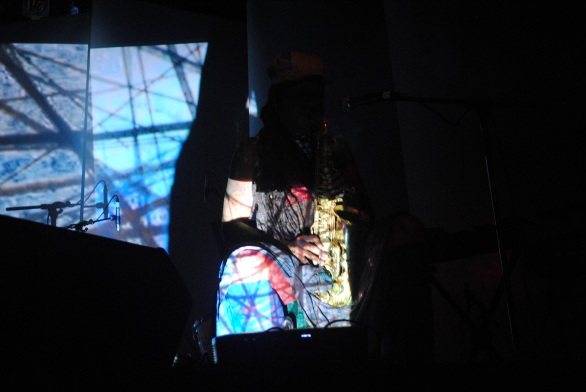
Playing in darkness as projections rolled behind her, Matana Roberts previewed work from the next chapter of her multi-media conceptual project 'COIN COIN' at The Great Hall as part of the Constellation Records showcase. Photo: Tom Beedham

Playing in darkness as projections rolled behind her, Matana Roberts previewed work from the next chapter of her multi-media conceptual project ‘COIN COIN’ at The Great Hall on Sept. 5 as part of Constellation Records’ label showcase. Photo: Tom Beedham

All throughout Roberts’s new number were her signature gloomy saxophone riffs, looped, layered, distorted, and eventually compressed into a doomy, overwhelming groan.  The deconstruction of her country’s narratives, memories, and self-perceptions made for an unforgiving post-America pastiche that was made all the more uncomfortable through ad nauseam repetitions and a time code that echoed the long histories of the piece’s disgraceful subject matter.

After the crowd responded to Roberts’s time travelling maxim mélange with a sea of applause, she gleefully asked the crowd, “Can I take you home?”

In a sense, she already had.

Prior to her own set, Roberts performed a workshop with Esmerine’s Beckie Foon and Jamie Thompson, which served as a segue after Foon’s own (brief) solo set as Saltland (which featured a cello-only rendition of Esmerine’s “Quelques mots pleins d’ombre” from Aurora). For the rest of the night, the live debut of Sandro Perri and Craig Dunsmuir’s DJ project Dundasa 80 was tasked with filling the void between stage sets, occupying a mixing booth at the front of the venue.

Fans that arrived early were forced to wait a little longer for their music as the night got underway about half an hour behind schedule, but they were soon treated to an enchanting performance from Jerusalem In My Heart.

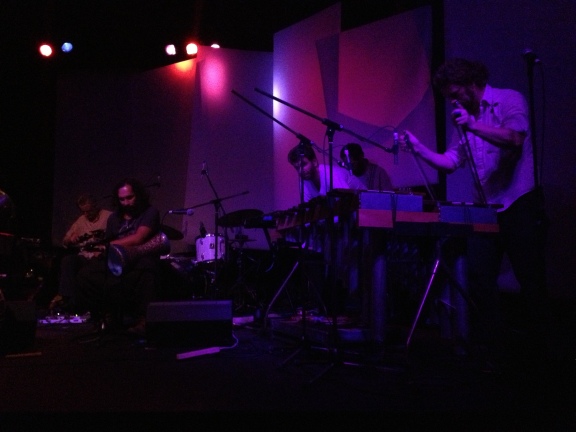
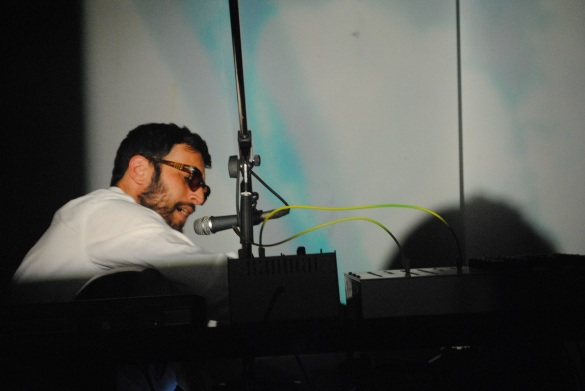
Radwan Ghazi Moumneh sings while tweaking delay speeds as Malena Szlam Salazar uses three 16mm projectors to send visuals onto screens behind him on the stage. Photo: Tom Beedham

Radwan Ghazi Moumneh sings while tweaking delay speeds as Malena Szlam Salazar uses three 16mm projectors to send visuals onto screens behind him on the stage Sept. 5 at The Great Hall for Constellation Records’ label showcase. Photo: Tom Beedham

A contemporary Arab multi-media project, JIMH opened the night with Lebanese national and experimental musician Radwan Ghazi Moumneh onstage and Chilean visual artist and filmmaker Malena Szlam Salazar jockeying a series of 16mm projectors from the crowd, looping strips of film featuring images of flickering flames, moons crossing across the night sky, or deer running through a brush as Moumneh used dual microphones to provide and loop vocals, also playing a saz and even performing vocals for an entire song through a talk box. It had the audience so spellbound it seemed to resist clapping between some songs for fear it might interrupt the performance.

Forget the caricature of the smartphone generation texting away as it waits for its headliner. Here, the audience was entirely present.

Clocking in around three hours, the Constellation Records showcase was a night that made for a transcendent and entirely immersive experience that demonstrated how it is still possible to stray far from the beaten path in pursuit of art and find an institution that will throw its weight behind you, at least in the arms of a certain Montréal facility. Other labels could learn from Constellation.

Esmerine Setlist:
“A Dog River”
“Walking Through Mist”/”Little Streams Make Big Rivers” medley
“Barn Board Fire”
“Translator’s Clos I”
“Translator’s Clos II”
“Lost River Blues I”
“Lost River Blues II”
“Yavri Yavri”

Encore:
“Histories Repeating As One Thousand Hearts Mend”

Related:
Colin Stetson, Sarah Neufeld, Richard Reed Parry workshop material with Sonic Youth’s Lee Ranaldo and Steve Shelley
Review: Colin Stetson at Hillside Festival
Review: Sarah Neufeld at Hillside Festival

Sex, drugs, and Dwarves

Bay Area shock rockers The Dwarves talk about their 30-year habits

Album artwork from The Dwarves's 1997 LP 'The Dwarves Are Young and Good Looking,' set to be reissued by Recess Records this September as 'The Dwarves Are Younger and Even Better Looking.' The Dwarves are performing material from the album, as well as others from its catalogue and yet-to-be-recorded material at stops along its current North American tour, which stops at Toronto's Horseshoe Tavern tonight.

Album artwork from The Dwarves’s 1997 LP ‘The Dwarves Are Young and Good Looking,’ set to be reissued by Recess Records this September as ‘The Dwarves Are Younger and Even Better Looking.’ The Dwarves are performing material from the album, as well as others from its catalogue and yet-to-be-recorded material at stops along its current North American tour, which stops at Toronto’s Horseshoe Tavern tonight.

With a back catalogue consisting of 14 albums, two DVDs, a number of both EPs and seven-inch records, San Francisco Bay Area punks The Dwarves exhibit a career that is anything but dwarfish. And over thirty years as a band, the group has racked up quite some habits. They’re currently in the middle of quenching one of their less illicit ones.

Touring across Canada and the United States’s Midwest and Northeastern states, The Dwarves make a stop at Toronto’s Legendary Horseshoe Tavern tonight, but fans that only know the mythology around the Dwarves shouldn’t let those impressions inform their decisions to catch the band on its current tour, Dwarves vocalist Paul Cafaro (a.k.a. Blag Dahlia) says.

In their salad days, onstage antics involving self-mutilation and live sex acts often turned Dwarves sets into abbreviated 15-minute performances, earning the band enemies among their earlier audiences and concert promoters. But as his band’s van rolled into Lincoln en route to a Chicago, Ill. gig, Cafaro – who has been one of The Dwarves’s two solely consistent members since its formation – explained over the phone Aug. 23 that fans who come out to Dwarves concerts these days will get more show for their buck.

“It’s generally like 45 minutes – the usual kind of thing,” Cafaro said.

Without any new material recorded since their 2011 10-inch record Fake ID, Bitch, the band is using its more lengthy sets to showcase material spanning its entire career.

“There’s songs from everything – from the Blood, Guts, & Pussy stuff and Sugarfix, [The Dwarves] Come Clean… then stuff from the last couple of records – [The Dwarves] Must Die, [The Dwarves Are] Born Again, even some brand new stuff – so new it hasn’t even been named yet,” said Cafaro.

The singer didn’t divulge much about the new material, but framed it and its contribution to the band’s sizeable (and ever-growing) discography as something that displays the band’s virtue when held up in comparison to those of other bands.

“Most bands suck. They make one good record and then they just flog it to death after that,” said Cafaro. “The Dwarves is just an embarrassment of amazing records. 30 years now. Mayhem.”

Also in celebration of The Dwarves’s career, the band recently announced a Recess Records reissue of its 1997 Epitaph LP The Dwarves Are Young and Good Looking, from which fans can also expect to hear songs at the band’s upcoming shows. Rebranded as The Dwarves Are Younger and Even Better Looking, Cafaro explained the Recess reissue will come complete with 40 minutes – or 22 tracks – of bonus material, all recorded during the “same time period” as the album proper:

Ten of them are from the solo EP that I did and the outtakes from that, which came right before Young and Good Looking, and then a bunch of it is a radio show that was never released. It’s The Dwarves live on the radio, Stanford. And then there’s like b-sides and stuff from the Young and Good Looking period.

Marking the band’s exit from Seattle, Wash. independent record label Sub Pop following a hoax the band propagated claiming the band’s guitarist (and only other consistent member) HeWhoCannotBeNamed (a.k.a. Pete Vietnamcheque) had been stabbed to death in a Philadelphia, Penn. bar fight, the original Young and Good Looking served as somewhat of a vehicle for a kiss-off to The Dwarves’s former label, containing a “modified” version of Sub Pop’s press release detailing the band’s departure in the liner notes. No word on whether that will also be collected in the reissue, but if Cafaro’s dismissal of even the mention of the group’s former label is any indication, don’t count on it:

I don’t get the fascination with those guys. No one’s cared about them since the ’90s. They’ve got nothing to do with me or anything. So I don’t know about them. Whatever they do is what they do. I have this band called The Dwarves. Not affiliated with whoever those guys are or whatever they’re doing.

The group’s website does promise the collection will come with “more classic photos of the naked skater chicks,” though: images consistent with the cover art for albums like Blood, Guts, & Pussy, The Dwarves Must Die, and The Dwarves Are Young And Good Looking itself, which all feature naked women covered in blood, wearing ski masks, or surrounding a dwarf pinned to a cross.

Such artwork has been known to bring The Dwarves condemnation from feminists and other critics in the past, but when asked about such controversy, Cafaro didn’t address how the band has been identified as exploitive and objectifying in its promotion of its material, but instead insisted, “these are classic shots,” and identified himself and his band as sex-positive, feminist crusaders, going on to discuss the reflections his artwork has received as “slut-shaming” type arguments that fail to see the album covers as glorifications of the female form.

“I consider myself to be a feminist, you know?” Cafaro said. “And I think one of the best things about femininity is nudity, so you know, we’re a great feminist band with all our naked album covers.”

“Lots of wonderful naked women. Lots of drug abuse and sex from The Dwarves. That’s what we’re about,” said Cafaro. “We’re very socially conscious and we’re on dope.”

Ah, yes. Dope.

That’s another thing The Dwarves have a thing for, and Cafaro says it’s something that excites him for the band’s Toronto visit.

“There’s nothing like Toronto drugs,” Cafaro meditated. “By the time cocaine gets to Toronto it’s been stepped on many, many times.”

Specifically Cafaro favours the idea of being in the same town as embattled Mayor Rob Ford, who admitted today that he has “smoked a lot of” marijuana and whom news media such as the Toronto Star alleged smoked crack earlier in the year.

“Don’t you guys have that mayor that smokes crack? That excites me. The idea of going to Toronto and smoking crack with a public official,” Cafaro said. “If he wants to come to the show, we’ll get him in free, and if he brings a prostitute, she can get in half price.”

The Dwarves play The Legendary Horseshoe Tavern in Toronto tonight with The Queers.

TURF reviews: Belle & Sebastian at Fort York – July 7, 2013

Belle & Sebastian band leader Stuart Murdoch charmed the crowd at Fort York as Belle & Sebastian closed out Toronto Urban Roots Fest July 7. Photo: Tom Beedham

Belle & Sebastian band leader Stuart Murdoch charmed the crowd at Fort York as Belle & Sebastian closed out Toronto Urban Roots Fest July 7. Photo: Tom Beedham

Kicking things off with an instrumental that amasses more sounds and contributors as it progresses, the sprawling B-side that is “Judy Is a Dick Slap” and its late ’80s/early ’90s game show theme comparisons provided a fitting opening number that also allowed Belle & Sebastian’s roster modest introductions to the crowd. For the most part, it operated simply as a vehicle allowing the band’s members to enter the stage as their contributions were cued into the mix, saving formal introductions for later and allowing their musical capabilities to speak for themselves.

The one slight exception was Belle & Sebastian founder and band leader Stuart Murdoch’s entrance, which involved the ceremonial closing of an umbrella. That action simultaneously signaled the end of the downpour that affected previous sets on TURF’s last day and the beginning of Belle & Sebastian’s. For anyone out of the loop, it also confirmed Murdoch’s place as the band’s central entertainer.

From there on, Murdoch was behind the wheel of one of the most charismatic, charming, and crowd involving concert performances Toronto has experienced this year so far.

That a Belle & Sebastian concert earns that title is probably directly due to the fact that so many of Murdoch’s pretty songs double as character profiles and critiques that mash up omniscient storytelling, dark humour, and twee instrumentals. It’s a delivery formula that sort of just necessitates audience familiarity, investment and captivity.

The real-life size of Murdoch’s subjects allows Murdoch to inject a heavy dose of literalism into his performances, and it certainly doesn’t hurt that he follows up on the opportunity.

The portion of Belle & Sebastian’s set perhaps most illustrative of such dramatics was its vaudeville performance of Murdoch’s bully-lamenting anthem about a boy that wore mascara, “Lord Anthony.”

Setting things up for the song, Murdoch had crowd members with access to the VIP pit pass off a tube of the aforementioned makeup to a girl in the front row. Later on, the singer left the stage, passed through the VIP crowd, and approached the girl only to have her theatrically apply it to his eyes, then climbing atop the barrier to pantomime the closing portion of the number and the words, “leave two fingers in the air” by doing just that with his middle digits.

Prior to an earlier performance of “The Model,” Murdoch called upon a girl in the VIP pit to join him onstage. Mentioning he was supposed to go on a date with the girl after the show, the two sat at a table and engaged in what the singer called “indie Scrabble,” playing a speedy, un-scored round of the game. Not letting the show go on without music for too long, Murdoch soon left his seat to start the song as other band members joined his “date” at the table to push the game along. At one point left to her own devices, the girl too left her seat to dance along onstage, even pretending to flash the crowd when Murdoch half-whispered the song’s line about “The girl next door who’s famous for showing her chest.”

Other tactics Murdoch enlisted in his TURF M.O. involved inviting a couple handfuls of fans onstage to dance during “The Boy with the Arab Strap,” dedicating “The Stars of Track and Field” to Wimbledon champion and fellow Scotsman Andy Murray, relating an alleged recent facial surgery that left him unable to whistle and thusly requesting the audience’s participation on “The Loneliness of a Middle Distance Runner,” calling on an audience member to get onstage and provide former band member Isobell Campbell’s spoken part on “Dirty Dream Number Two” (she sang the part when the band got there, but such is a risk that comes with the territory of selecting crowd participants at random), and taking asides in the middle of songs to censor his more colourful lyrics because of the festival’s “all ages” demographic or alternatively to greet remarkably well-behaved babies in the VIP pit (learning parents take note: Belle & Sebastian’s bedroom pop is newborn friendly).

Of course, Murdoch doesn’t have to engage in kissing baby campaign tactics to win over his audiences; it all just cements his place as the favoured Belle & Sebastian frontispiece.

Fans tend to puff up at songs from Belle & Sebastian’s more democratic period featuring lead vocals from any member that is not Stuart Murdoch, and as if in a display of sympathy, the only related offense the band committed at TURF was facilitated through “To Be Myself Completely,” led by guitarist Stevie Jackson. Murdoch didn’t seem to mind the break from the spotlight, but you could catch him receive an authoritative elbow from violinist Sarah Martin after delivering one of his backing parts on the song, so maybe he has a thing against letting Jackson do what his existential number is about.

The band rounded off the regular portion of its set with If You’re Feeling Sinister closer “Judy and the Dream of Horses,” only to return with an encore they insisted they were merely providing at the insistence of a man that stopped them from making their way to their van (festival founder Jeff Cohen, perhaps?). They played “Get Me Away From Here, I’m Dying” as if to reify Murdoch’s intent to finish with material from what he’s referred to on-and-off as his best collection of songs, and that was it. Toronto Urban Roots Fest was over.

Touring just ahead of Aug. 26-due collection The Third Eye Centre, it might have come as a surprise (and maybe a disappointment) to eager fans that Belle & Sebastian didn’t delve into some deeper cuts – the closest they got to promoting their “new” product was with “I’m a Cuckoo” and “Your Cover’s Blown,” only appearing on the compilation as Avalanches and Miaoux Miaoux remixes (respectively) – but it would have been difficult to argue with the band’s self-aware and sweeping representation of its back catalogue.

Setlist:
“Judy Is a Dick Slap”
“I’m a Cuckoo”
“Another Sunny Day”
“The Stars of Track and Field”
“Dirty Dream Number Two”
“To Be Myself Completely”
“Lord Anthony”
“The Model”
“Piazza, New York Catcher”
“The Loneliness of a Middle Distance Runner”
“Your Cover’s Blown”
“I Didn’t See It Coming”
“The Boy with the Arab Strap”
“Legal Man”
“Judy and the Dream of Horses”

Encore
“Get Me Away From Here, I’m Dying”

Originally published by The Ontarion.

TURF reviews: Whitehorse at Fort York – July 7, 2013

Whitehorse’s Melissa McClelland improvises a microphone out of a phone receiver at Fort York for Toronto Urban Roots Fest July 7. Photo: Tom Beedham

Whitehorse’s Melissa McClelland improvises a microphone out of a phone receiver at Fort York for Toronto Urban Roots Fest July 7. Photo: Tom Beedham

Whitehorse is husband and wife Luke Doucet and Melissa McClelland’s band. Hamilton-bred, they moved to Toronto a week before TURF and share their band’s name with a city in Yukon. The layers of the group’s genesis are many, but there’s a minimal chance they outweigh those of its sonic output.

Putting on their best mad scientist impressions, Whitehorse spent the first half of their TURF set singing through telephones, banging on anything they could get their hands and drumsticks on, picking through rock star guitar solos, and looping all of it to serve up a heavily layered Dagwood of sound.

Then they flipped the switch to unfiltered an country serenade built on dual acoustic guitars.

While it’s hard to isolate the band under the heading of a general genre, their set at TURF certainly made it acceptable to slap “experimental” in front of any category you might suggest.

Originally published by The Ontarion.

TURF reviews: Flogging Molly at Fort York – July 6, 2013

Flogging Molly performed at TURF July 6, 2013. Photo: Tom Beedham

Flogging Molly performed at TURF July 6, 2013. Photo: Tom Beedham

Walking onto a stage with cans of Guinness perched atop every amp, Flogging Molly worked hard at entertaining what was easily TURF’s largest crowd of staggering drunks, which regularly, wouldn’t have offered much surprise, except when it’s taken into consideration that alcoholic beverages at the festival were priced at nine bucks a pop.

The punk affected band finding its place on the urban roots festival’s docket with its connection to traditional Celtic folk music, it was only fitting that Irish-American pub punk should come packaged with a sense of humour. Lead singer/guitarist Dave King followed suit by perforating a setlist packed with songs like “Whistles The Wind,” “The Present State of Grace,” and “Float” by cracking wise about the number of photographers filling the media pit during the first three songs and how somebody better get his good side (which he suggested was probably his behind). The frontman also supplied groan-rendering segues that linked things like a Hold Steady-dedicated “Saints & Sinners” to bassist Nathen Maxwell, the “wonderful sinner who can’t hold anything steady” and opens the bass-carried track, as well as the “lucky bastards” living in Toronto and – “speaking of bastards” – “Requiem For a Dying Song,” written for George W. Bush.

King also did well at reminding fans of the band’s family-oriented disposition, dedicating “Drunken Lullabies” to his father Richard and went on to introduce banjo player Bob Schmidt, but not without mentioning the recent birth of his daughter before diving into the banjo picked lead of “Drunken Lullibies.”

With VIP ticket holders allowed to fill the space left by photographers after the band’s first three songs, before “The Kilburn High Road,” King pointed out relatives standing before the stage, and then introduced his wife and bandmate, Bridget Regan, who supplies the prominent tin whistle featured on the track.

A set that evoked the only circle pits had at the Fort York-held portions of TURF, it’s safe to say that it was all a working formula, too.

Originally published by The Ontarion.

TURF reviews: The Hold Steady at Fort York – July 6, 2013

The Hold Steady played their first Toronto performance in three years at July 6 at TURF. Photo: Tom Beedham

The Hold Steady played their first Toronto performance in three years July 6 at TURF. Photo: Tom Beedham

When The Hold Steady took the west stage at TURF, frontman Craig Finn commented on how, at lots of concerts, bands don’t need introductions, modestly proposing, “We do.”

Indeed, the band had its share of lead-ins. TURF co-presenter Donny Kutzbach from Funtime Presents, Canadian sports broadcaster Dave Hodge, and even English folk singer Frank Turner – who aired his excitement over The Hold Steady’s set earlier during his own on the west stage – all appeared onstage just before the indie rock group’s set to offer forwards.

But even for some that have already been enjoying the band for years, the concert was an introduction (or an update) of sorts, as any that might have missed their Toronto performance at the Phoenix in 2010 had yet to be exposed to the band live without keyboardist Franz Nicolay or with the addition of new guitarist Steve Selvidge.

Still, if there was anyone more excited for the band to be onstage at TURF than Turner, who lowered himself into the VIP viewing area in front of the stage before The Hold Steady began, Finn would have been a good contender.

Providing one of the most animated sets Fort York saw over the course of the weekend, the audience was made fully aware of The Hold Steady’s need for Selvidge’s second guitar as Finn neglected his to theatrically raise his arms in the air, point at fans, and pull at what’s left of his hair while singing with a smile on his face and a head that looked like it might explode from all of the energy.

Between songs, he engaged the crowd with a bait about visiting the Sky Dome earlier in the day to see his favourite team play a ball game (the Minnesota Twins).

The band played “Chips Ahoy,” “Hurricane J,” “Magazines,” “Rock Problems,” “Sequestered in Memphis” and “The Swish,” as well as some material they announced they would be recording in studio shortly thereafter.

They closed out the action on the west stage with “Stay Positive,” featuring Frank Turner.

Originally published by The Ontarion.

TURF reviews: The Lowest of the Low at Fort York – July 6, 2013

’90s alterna-rockers The Lowest of the Low performed July 6 at Toronto Urban Roots Fest. Photo: Tom Beedham

’90s alterna-rockers The Lowest of the Low performed July 6 at Toronto Urban Roots Fest. Photo: Tom Beedham

Seeing The Lowest of the Low listed on TURF’s lineup hinted at some programmed disregard of the roots music promised by the nomenclature of Toronto Urban Roots Fest, but not disregard that was unwelcome. Giving the audience a chance to hear one of the greatest Canadian singles of the ’90s, “Salesmen, Cheats, and Liars,” straight from its source was not just a set highlight from the thrice-revived alt-rockers (indeed, the wisdom sported on the backs of fans’ t-shirts spotted at TURF – “There’s no life like low lifes” – rings true), but a festival highlight on its own. The band also performed new songs, noting a return to the studio would soon follow – so get excited for that, Low Lifers.


Originally published by The Ontarion.